
Sermon for Sunday, April 20, 2025 || Easter Day || John 20:1-18
Good morning and welcome to St. Mark’s on this Easter Sunday morning. I am so glad to be here worshiping with you today on this most sacred of all Feasts of the Resurrection. On this day, we proclaim that nothing in all creation, not even death, can separate us from the love of God in the power of the Risen Christ. On this day, we celebrate the emptiness of the tomb and the fullness of new life granted through the Resurrection. On this day, we run alongside Mary Magdalene and Simon Peter to witness the miracle of miracles.

“WheretheWind.com Sermon” on your podcast app of choice.
But before we start our run, we need to introduce the other character in the scene. The Gospel tells us that Mary raced to tell two people about the empty tomb: “Simon Peter and the other disciple, the one whom Jesus loved.” This is such an odd element of the Gospel that we need to spend a few minutes unpacking it. Who is this “other disciple, the one whom Jesus loved?”
The tradition of the Church tells us that this beloved disciple is John, one of the Twelve, a Galilean fisherman like Peter, Andrew, and James. This John is the person who gave his authority to the account of the Gospel that bears his name. We call the writers of the Gospel of John the “Johannine Community” for this reason. (“Johannine” comes from the Latin way of saying “John.”)
But I’ve never been persuaded by this tradition. I prefer a more literary understanding of calling this person “the disciple whom Jesus loved.” I think the writers of the Gospel accomplished something masterful with this odd choice of naming (or really not naming) a character. I think the writers intended for this beloved disciple to stand in for the reader of the Gospel. Each of us is meant to place ourselves in the sandals of this disciple because each one of us is the disciple whom Jesus loves.
Seen in this light, we can look back at the Gospel and find ourselves in a few important scenes. The beloved disciple pops up first at Jesus’ side during the Last Supper. And guess what? We will be there at the Last Supper in a little bit when we celebrate Holy Communion, partaking of the Body and Blood of Christ along with those disciples in the Upper Room. The beloved disciple appears again during the Passion narrative, staying near Jesus when the rest flee, and standing with Jesus’ mother at the foot of the cross. And guess what? We did the same on Good Friday, remaining with Jesus at the cross, sitting vigil as he accomplished his mission and breathed his last.
Today’s Gospel reading is the beloved disciple’s third appearance. This “other disciple, the one whom Jesus loved” runs ahead of Simon Peter and reaches the tomb first. So now that you know that you are this beloved disciple, I invite you to imagine your way to the moment when you reach the tomb and look inside.
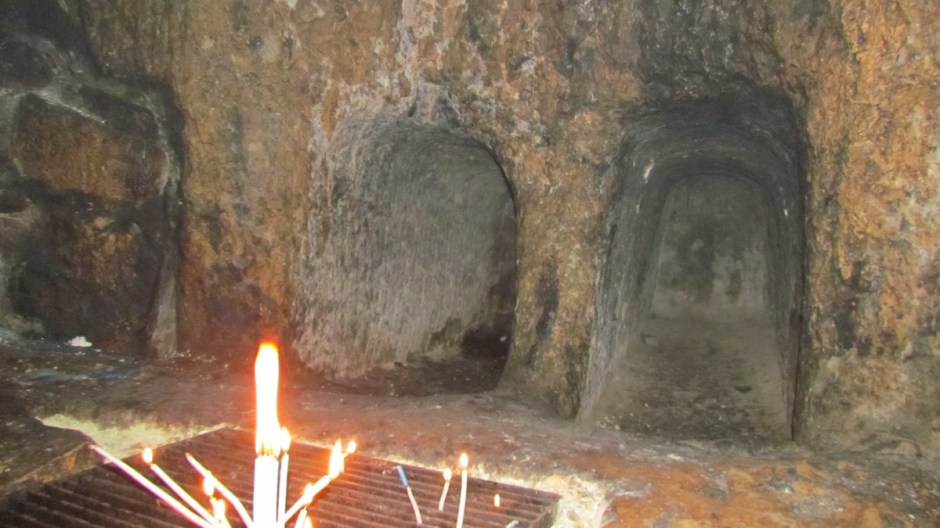
The tomb sits in a garden near the walls of Jerusalem. It is a brand new tomb into which no body has ever been laid. This detail is odd to American ears because we are used to burying people in the abundant land around us. But in ancient Israel – and in modern times in many places around the world – a tomb like the one Jesus was laid in was a temporary holding place. The body would be wrapped for burial, anointed with funereal balms, and placed in the tomb. Then the tomb would be sealed with a stone and the stone mortared into place with clay. Several months later, the tomb would be unsealed. The desiccated remains, now unburdened by flesh that could rot and smell, would be transferred to an ossuary, a place for the collection of bones.
So there you are, the beloved disciple, bending down and looking in this brand new tomb in the midst of a blooming garden. The space isn’t much larger than the body that should be present – perhaps two or three feet tall and wide and six feet deep. In any case, you have to stoop to look inside. You see the linen burial cloths lying there – and now for an odd detail. You see the linen face cloth apart by itself, neatly folded. You tell yourself that there’s no way graverobbers would unwrap the body, never mind fold up the cloths like laundry. Something else is going on here – something beyond miraculous.
Peter catches up with you, pushes past, and crawls inside the tomb. He sees what you see, but Peter’s heart is not ready to believe what his eyes perceive. But your heart is. You sat by Jesus at the Last Supper, feeling his overwhelming love for you as he passed you a piece of bread, a piece of himself. You stood by the foot of the cross, feeling his never ending love for those who suffer beneath the rod a violent and death-dealing empire. You took his mother’s hands in yours as Jesus, with his final breaths, gave her into your care. You feel his binding love in the twining connection he makes between the two of you, a new life-giving relationship born at the moment of his death.
And now here you are, looking at the cast aside linen cloths, looking at the face cloth neatly folded in the corner. As the Gospel says, you “see and believe.” The question is: what do you believe? Or better yet, what does your belief mean? In the Gospel according to John, the concept of “belief” is synonymous with “an abiding relationship with Jesus.” Belief is not simple assent to a set of doctrines or creeds. Belief and relationship go hand in hand. Belief, also called “faith,” is the active component of our side of the relationship with the Risen Christ. And the active component of the other side is the eternal love of our eternally loving God, a love that stitches us into the very fabric of the heart of God.
We are the beloved disciple. We see the empty tomb and we believe in the Risen Christ – not in a bland, cerebral way that turns our faith into series of statements. No. We believe in the Risen Christ as we walk with Christ along the path of faith, hand in hand, claiming our eternal lives in the midst of our earthly lives and sharing the enlivening power of God’s love with everyone we meet. We are the beloved of God and this belovedness grants us the strength and the grace to walk the path of faith. This belovedness allows us to see everyone else as God’s beloved as well. This belovedness is what we proclaim today – that nothing in all of creation, not even death, can separate us from the love of God in the power of the Risen Christ.
 Where the Wind...