
(Sermon for Sunday, November 21, 2010 || Christ the King, Year C, RCL || Colossians 1:11-20)
Ever since I bought my piano a little over two years ago, a stack of music has sat atop the instrument gathering dust. Bach, Mozart, Beethoven, Chopin, Brahms, Debussy – the keyboard works of these great composers continues to fulfill the lackluster role of impromptu lamp stand. To make matters more pathetic for this stack of music, the lamp, which I purchased at the same time as the piano, was bulbless until a few weeks ago when I finally remembered to pick up a bulb at the grocery store.
You might wonder why I bought a piano at all, if I never get around to tickling the ivories. Good question. At the time, I had grand designs, which have since descended through the realm of simple designs and the land of hope and settled comfortably in the valley of pipe dreams. Perhaps, my future children will learn the instrument one day and redeem their father’s purchase. Recently, my fiancé has sat down and played for a few minutes here and there. But mostly, the piano simply takes up space. And the stack of music atop the instrument gathers dust.
But this stack of music gathering dust isn’t really music at all. The books of Beethoven’s sonatas and Chopin’s waltzes and Debussy’s preludes are simply bound pages adorned with groups of five lines and thousands upon thousands of cryptic markings. We might call these pages by the name of “sheet music,” but the “music” exists wholly apart from these “sheets.” Only when a person, who is trained to decipher and articulate the cryptic markings, sits down with the intention of translating the notes into sounds does the music ever have a chance of happening.
Our lives follow this same pattern. We have the capacity to make beautiful music with our lives, but mostly we keep our lids closed, content to exist as furniture taking up space. Mostly we keep our covers closed, content to sit in a stack of unread books. Mostly we sit around gathering dust.
Of course, this manner of existence is not the life that God yearns for us. Today, on the final Sunday of the church year, we celebrate the reign of Christ. We give thanks for the reality that Christ is our sovereign, our ultimate authority. And in our celebration and thanksgiving, we acknowledge that Christ does not reign over a world full of inanimate furniture and closed books. Rather, Christ reigns precisely to pull and push and prod us out of the state of dust gathering.
To start shaking off the dust, we must first examine just what we mean when we claim that Christ reigns. As the One who reigns over us, Christ is our ultimate authority, but we encounter trouble when we link Christ’s authority to the paltry earthly authority we encounter on a daily basis. Certain people have authority over us based on their roles. Teachers and principals have authority over students. State troopers have authority over motorists. Judges have authority over those indicted of crimes. This earthly authority has its roots in a punitive system, where citizens cede a portion of their personal sovereignty to certain offices in order to make the society function more smoothly. People recognize that if they break the rules of the society, the Authorities have the right and the ability to punish.
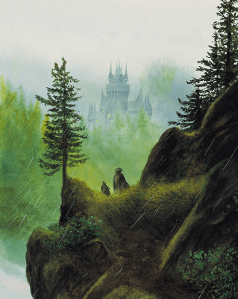
We may use the same word, but Christ’s authority is of a wholly different sort than the kind we encounter in our principals, state troopers, and judges. Far from being simply punitive in nature and bound by office or title, Christ’s authority arises from Christ being the author, the writer of the great script of creation. Think of it like this: before J.R.R. Tolkien put pen to paper, Middle-Earth had no ability to capture the imagination of readers. But over forty years, Tolkien authored story after story, character after character, slowly building a world of dark forests and misty mountains inhabited by elves and hobbits and wizards. Tolkien is the authority behind Middle-Earth because he authored the fantasy world into existence in the minds of his readers.
In his letter to the Colossians, Paul speaks of Christ’s authorship in similar terms: “In [Christ] all things in heaven and on earth were created, things visible and invisible, whether thrones or dominions or rulers or powers – all things have been created through him and for him. He himself is before all things, and in him all things hold together.”
As the author of all things, Christ has reigned since before the first things were created. And the script of creation continues because Christ has never stopped writing. And now Christ has authored our lives into being. We are small stories that help make up the great script. At the end of the Gospel according to John, the narrator concludes: “But there are also many other things that Jesus did; if every one of them were written down, I suppose that the world itself could not contain the books that would be written” (John 21:25). What the narrator doesn’t say is that all the other things Jesus did have been written down. Christ, the author of each of us, wrote those things down in us. We are the books that the world itself cannot contain.
The problem is that too often we are the books sitting atop the piano gathering dust. Too often, we fail to remember that we are not our own authors. Too often, we fail to acknowledge that we are not in charge of our own lives. Today, we proclaim that Christ reigns in each of us. Christ is in charge of our lives because Christ continues to author us into being. The author has written the words of life within us, the special words unique to each of us. When we begin to seek for those special words, when we look inside ourselves and begin to read the story of how Christ reigns in our lives, we start to shake off the dust.
Like the sheet music, we are just closed books until we begin to participate in the telling of our own stories. As the author of each of those stories, Christ has penned a work about himself, a work which we proclaim in the living out of our stories. We could choose to stay atop the piano gathering dust, but what kind of forlorn existence does this entail? How could we read the words of Christ in the lives of those around us if we remained dusty, closed books? There is far too much love and grace in the pages of our lives for us to waste them by staying closed. There is far too much that Christ is doing for us not to participate in Christ’s reign. There is far too much beauty to bring to the world for us not to let the author spill the words of life from our stories into creation.
And so, as one book trying to shake off the dust, I ask you: how does Christ reign in you? What words has the Author of each of us written in your hearts? Or, to use the words that close Mary Oliver’s poem “The Summer Day”:
“Tell me, what is it you plan to do
With your one wild and precious life?”
 Where the Wind...