
Ever wonder where all that stuff in the Christmas pageant comes from? Haven’t seen a felt board since you were six? Well, then look no further than this third installment of the Moving Picture Bible Study.
Tag: where the wind
Fully human
The following post appeared in the Advent issue of Episcorific (a ‘zine for and by the 20s and 30s of the Episcopal Church). You can download the full magazine in .PDF form here.
* * *
 The trouble with being human is that most of us aren’t very good at it. We are way better at being couch potatoes or social butterflies or unique snowflakes or chickens. We explain the very act of making more humans by referring to the birds and the bees. A frightened human is a scaredy cat; an insufferable one is a less polite term for donkey. We may exist as humans, but we spend a lot of time filling the roles of other species.
And these other species are darn good at being themselves. Bees fly around collecting nectar and pollinating flowers. Trees keep soil from eroding. Grass scrubs the air of carbon dioxide. Cockroaches allow husbands to feel manly. If evolution teaches us one thing it’s that species thrive when they don’t try to fill the role of some other species.
While we are busy being butterflies and potatoes, we forget that in reality we are human. And who really wants to be human? Our skin isn’t very well adapted to our climates. Our young can’t fend for themselves for at least twenty-two years. Our bodies break down with alarming frequency. And to top it off, I can’t think of another species on this planet that kills its own kind with as much regularity and aplomb as we humans.
But somehow we have survived down through the ages amidst the dangers of saber-toothed tigers, drought, pestilence, war, and deficit spending. We have survived, but, as Tennyson writes, “We are not now that strength which in old days / Moved earth and heaven.” I’m not even convinced that we’ve ever been that old strength. I don’t think that we’ve ever lived into our humanity to the greatest extent possible.
And here’s where Jesus comes in. Jesus didn’t come to show us a new way to be human. Jesus came to show us how to be fully human. The Gospel makes a big deal about Jesus’ own humanity. Matthew and Luke talk about Jesus’ birth. John shows Jesus tired, angry, and sad. In all four accounts of the Gospel, he is brutally murdered. And why present God the Son as such a frail collection of bones and tissue and synapses? Well, he couldn’t be the “Word made flesh” without flesh. And he couldn’t be our hope and our salvation without fully identifying with our lives, however “nasty, brutish, and short” they may be (thanks to Thomas Hobbes for those appropriate adjectives).
So Jesus is fully human – not some ghost or apparition or hologram. And he’s fully divine. 100% of both. This 100% of humanity is the real miracle here. It’s impossible for God not to be 100% divine (God wouldn’t be God without the perfect batting average). But it’s very possible (indeed, likely) to be less than fully human. Jesus succeeded in realizing this unlikely full humanity, and that’s one of the reasons he’s so special. His life and his example teach us to be fully human.
If we aren’t fully human now, what takes up the rest of the space? In Mere Christianity, C.S. Lewis explains this question well. Lewis calls us “toy soldiers.” We begin as automatons – clockwork beings in need of winding and direction. But God doesn’t want toy soldiers. God wants sons and daughters to love and adopt as God’s children. Jesus’ example and his grace enable us to move through the messy, painful, joyous process of outgrowing our clockwork. Only by becoming fully human, can we fully embrace God’s love for humanity. If we can recognize God’s love for humanity, perhaps we can love other humans, as well.
Food (namely herbs and stewed rabbit) for the journey
The following post appeared Wednesday, December 9th on Episcopalcafe.com, a website to which I am a monthly contributor. Check it out here or read it below.
* * *
The hobbits Frodo Baggins and Samwise Gamgee arrive in a heather-strewn woodland between the River Anduin and the mountains that border the dreaded land of Mordor. After some walking around and griping about the knavish Gollum, who is their deranged hostage and guide, they sit down for a meal, as hobbits often do. They eat herbs and stewed rabbit and then…
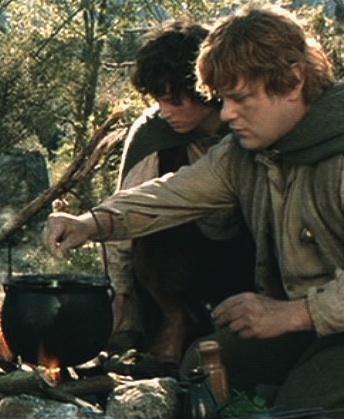
…I have no idea what happens next.
I’m twelve years old, and I have made it nearly two-thirds of the way through The Lord of the Rings. But I can no longer bear it, and I shelve the book. It’s just so boring. All they do is walk! They start in one place, walk for a bit, meet someone and chat, and then walk some more! I just want them to get somewhere! I want to yell, “Get to your destination, Frodo – don’t stop to eat herbs and stewed rabbit, which the author has described in painstaking detail! Just get to the mountain and be done with the ring! Enough of this walking…”
A year later, I’m thirteen (a much wiser and more mature age), and once again I pick up The Lord of the Rings. Maybe this year, I’ll finish it. I begin at the beginning, and they walk and meet folks and chat and run away from enemies and Frodo and Samwise reach the heather-strewn woodland and eat herbs and stewed rabbit and then…
…I have no idea what happens next.
My wisdom and maturity are no match for the walking. Again, I stop reading. The quest is just too long and arduous and their destination is still on the other side of the mountains and several hundred pages away.
A year later, I’m fourteen, and I pick up The Lord of the Rings again. On page 641, Frodo and Samwise sit down for a dinner of herbs and stewed rabbit and then…
…I keep reading. They find themselves in the middle of an ambush, Sam sees an oliphaunt, the hobbits are captured by people who are supposed to be on their side, and the story goes on and on. A few days later, I finish it. And I’ve read it at least eight more times since.
Finally, at fourteen, I could appreciate the journey, and let the destination take care of itself. Tolkien understood that a destination is more than a physical place. A destination is the culmination of all the shaping events of the journey that brings you to that ultimate location.
Every year, after the tryptophan has worn off, we begin just such a journey in our walks with God. While secular Christmas disgorges itself out of shipping containers every year the day after Thanksgiving, we have the opportunity to let Christmas happen only after the four weeks of Advent have run their course. Christmas is the destination. And Advent is about not arriving at your destination before you are shaped by the journey.
Have you ever had the soup du jour at a restaurant? It’s not some fancy French dish. It’s just the soup made for that particular day. Likewise, my journey happens every day. Every encounter, every decision, every road taken or not shapes me. The season of Advent gives me a dedicated four weeks to notice the shaping influence each day has on my journey with God.
On the first Sunday of Advent, we heard the psalmist pray, “ Show me your ways, O Lord, and teach me your paths…All the paths of the Lord are love and faithfulness” (25:3, 9). This Advent, I’m adopting this prayer because I’ve always had trouble not skipping to the end of the story. Every year of my childhood, I wanted to open the windows of my Advent calendar all at once. I just couldn’t wait to open tomorrow’s window tomorrow. Now, at twenty-six (a much wiser and more mature age) I pray for God to give me the patience to notice each day’s impact on my life. When I ask God to “teach me your paths,” I’m not hoping for some inside knowledge about the destination. I’m simply asking for guidance along the road.
Some time ago, I heard this illustration (the origin of which no longer resides in my brain). Have you ever noticed that headlights only show you thirty or forty yards ahead of your car on a dark night? But they still get you to your destination. Likewise, God teaches me God’s path even as I am struggling to stay on it. As I walk towards Christmas on this particular Advent journey, Christ walks a few steps ahead of me, illumining the road to his own nativity, to his own unique and wonderful expression of love and faithfulness.
Despite my opening description, my love for Tolkien’s works of fiction is deep and abiding. They taught me the lesson of Advent: don’t arrive at your destination before being shaped by the journey. I pray that, during this season of Advent, God teaches us God’s paths, which are love and faithfulness. And I pray that we may meet someday on the road, about which Tolkien’s Bilbo Baggins rhymes:
The Road goes ever on and on
Down from the door where it began.
Now far ahead the Road has gone,
And I must follow, if I can,
Pursuing it with weary feet,
Until it joins some larger way,
Where many paths and errands meet.
And whither then? I cannot say.
 Where the Wind...