Yesterday, Today, and Forever

(Sermon for Sunday, September 1, 2013 || Proper 17C || Hebrews 13:1-8, 15-16)

Stories are powerful things. Sharing stories helps us make meaning, pass on tradition, teach lessons, deepen relationships, learn from one another’s experience, and grow closer to God. You may have read in the Carillon that this year at St. Stephen’s we are going to practice sharing our stories, so I thought I’d get a jump start – a sneak preview, if you will – during this sermon. I’d like to share with you three stories, all sparked by a single verse from today’s reading from the Letter to the Hebrews. I’d like to share with you a story about Jesus Christ yesterday, a story about Jesus Christ today, and a story about Jesus Christ forever. Each of these stories is about Jesus and about me, and if I do my job right, each will also be about you.
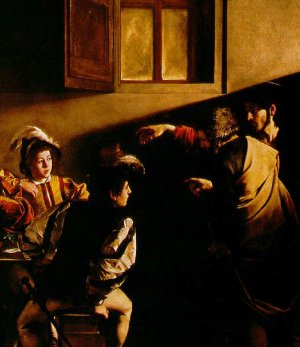
Detail from "The Calling of Saint Matthew" by Carvaggio)
Detail from “The Calling of Saint Matthew” by Carvaggio)

We’ll start with Jesus Christ “yesterday,” and we’ll start as many Godly Play stories do. Once there was someone who said such amazing things and did such wonderful things that people followed him. This someone was called Jesus of Nazareth, and he came from seemingly humble beginnings, though his mother knew better. At his birth a disreputable cadre of outcasts claimed him as their savior, and that’s what he was. His very name means “God saves.” When he grew up he left his mother’s house as sons often do, but that was perhaps the last normal thing he ever did.

“Change your hearts and your lives,” he preached to any who would listen. “Because the kingdom of God is so close you can taste it.” This was his good news, his Gospel. But that was not all. Every day he revealed what it was like to live in God’s kingdom, God’s dream for all creation. He healed those who were sick and those who couldn’t walk or see. He renewed the broken to wholeness, he gave hope to the despairing, and he welcomed everyone, especially those no one else would bother with, to his table. His words provoked peace, joy, and courage in some, but, sadly, malice in others.

Jesus told his friends to love and serve others, come what may. He stood against the machinery of the world that enslaves people with false promises and misplaced priorities. He desired with every fiber of his being to replace the machine with a life lived fully in God, a life of blessing and abundance derived from God’s promises, God’s priorities. In the end, the machinery of the world felt threatened by this man, who was also so much more than a man. And for good reason. He was a threat. By putting Jesus to death – and a shameful death at that – the machine thought it had won. But on the cross, Jesus gathered to himself all the brokenness the world wrought, all that separates us from God – sin, shame, guilt, death – and their power died with him.

This is the story of Jesus Christ yesterday. When I read this story in the Gospel, I feel his words penetrate my skin. They delve into my heart and take up residence, and they urge me to live the life Jesus invited his followers to live. As I read Jesus’ story, I long to make it my story. And this is where the story of Jesus Christ “today” begins.

Three days after Jesus died, he rose again. Before dawn that Sunday morning, God the Father returned God the Son to us, resurrected as Jesus himself, yet more than himself. He couldn’t bear to break the promise to be with us always to the end of the ages, so he conquered death itself in order to stay in relationship with us into eternity. He breathed the peace of his Holy Spirit onto his friends, and we are still breathing those breaths even today.

We are still breathing those breaths not just because the two thousand year old air still remains, but because Jesus’ resurrection has no use for the concept of time. While we mark that Sunday morning as the hinge of history, the resurrection did not happen just on that one morning in that one garden. The power of the resurrection emanates out from that moment into every moment, filling all moments with the possibility of entering fully into God’s eternal presence. Jesus’ resurrection ushered in the deeper reality of God’s dream, a dream that each of us can participate in, a dream of bringing God’s reign into the hearts of all people and all people into the heart of God’s love. Jesus’ resurrection is happening now, today, in this place, in our hearts, at our table, in our service, in our love. When I remember the startling truth of this wonderful story, I take the time to look for signs of Jesus’ resurrection in my life. And I try to be a sign of that resurrection in the lives of others.

But there is still one more story, the story that undergirds all the others, the story of Jesus Christ forever. Our first story began with God the Son emptying himself, taking on the form of a human being, and becoming like us so we could become more like him. The Gospel writer John resorts to poetry to enter even the edge of the mystery of this emptying. The Word, says John, was in the beginning with God and was indeed God. This Word became flesh and dwelled among us and we have seen his glory, the glory of God spilling from the person known as Jesus of Nazareth.

But as the Word, he is forever. This Word is the order, the logic behind all of creation. “All things came into being through him,” John’s poem continues, “and without him not one thing came into being. What has come into being in him was life.” Whenever we look up and try to count the stars, whenever we appreciate the beauty and richness of evolving plants and animals, whenever we smell the coming rain, we encounter the artistry of the Word, the foundation of all things, visible and invisible. This eternal Word was in the beginning with God and abides with God and is God forever. This is the story upon which all others hang, and this is the story that Jesus invites us into. This is the story of God’s presence in and through creation.

This is my story. And this is your story. We read Jesus’ words. We feel them come alive in us through the power of the resurrection. We join God in the great story of bringing all God’s creation back to God. These stories are grand, and sometimes they seem so big and daunting that entering them feels impossible. But its in those moments when Jesus Christ – the same yesterday, today, and forever – takes us by the hand and reminds us that each normal day of our lives is part of the story whether we realize it or not. He takes us by the hand and invites us to follow one step behind him as he opens our eyes to all the ways we are already part of the story. And he takes us by the hand to guide us to all the new ways the story is still unfolding.
They Call it Heartbreak Hill

I first published this reflection on the website Day1.org. You can see it here.

fenceThey call it Heartbreak Hill. It rises between the twentieth and twenty-first miles of the route of the Boston Marathon. It’s not much of a hill, unless you’ve been running for twenty miles and have no more glycogen left to power your leg muscles. You see this gradual rise and you know you only have six miles left, but then you hit the wall and your will to keep running vanishes. That’s why they call it Heartbreak Hill.


But at yesterday’s marathon, the heartbreak was elsewhere. It was at the finish line, where the bombs detonated. It was on Boston Common, where the final waves of runners were rerouted and then left to seek out frantic family members. It was at local hospitals, where trauma teams worked round the clock with valiant and tireless conviction. It was in the heart of each of us watching the confused, yet ardent news coverage.

And it was in the heart of God.

The heart of God broke yesterday along with ours. The heart of God broke for those who died in such senseless savagery, for those who were maimed, and for those who love them. The heart of God broke because those of God’s children who perpetrated this act of terror have severed themselves from the image of God within them.

So what are we to do with a God who has a broken heart? The answer might surprise you. What are we to do? Rejoice. Why? Because our God is a God of compassion, a God who suffers with us, a God who was there yesterday when the plumes of smoke began to rise and the tears began to fall.

To rejoice, we do not have to stop feeling sad or angry or lost or afraid. As a matter of fact, the most sincere rejoicing happens when we feel such feelings. To rejoice is to take joy, and joy is the abiding sense of God’s connectedness with God’s creation. Today, we need to feel that connection, we need to feel God suffering with us, and we need to feel God’s heart breaking. We need to feel these things because when God’s heart breaks, our own broken hearts are drawn to it – mystically and magnetically.

I live a short bus ride, a red line train ride, and a green line train ride from Copley Square. I have walked past Marathon Sports many times in the last few years, usually on the way to a restaurant or Trinity Church. But every time I walk by it now, I will remember God’s heart breaking yesterday and swallowing all of our collective brokenness into its depths of love.

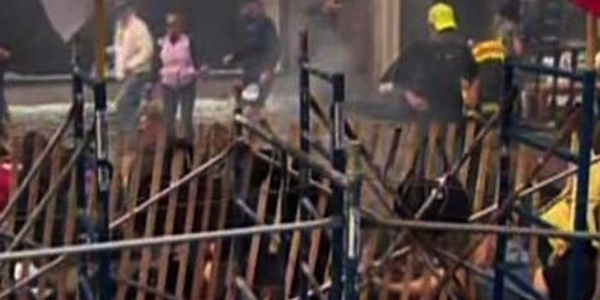
Speaking of love, there’s an image from yesterday’s shaky video footage that I can’t get out of my mind. Within thirty seconds of the first bomb’s detonation, emergency responders were running to the sight of the blast. But they couldn’t get there because a barrier had been erected to separate the spectators from the runners. So the emergency personnel started tearing at it, stomping on it, and pulling it with all their might. It took a dozen of so of them to move it, but once they exerted their frenzied energy, the barrier didn’t stand a chance. They dragged the multiple layers of the wall into the street and rushed to help the victims.

I can’t think of a better image for what God accomplished in the resurrection of Jesus Christ, which we continue to celebrate during this season of Easter. Once for all, God tore down the barrier between life, death, and new life. God proclaimed God’s willingness to stay connected to God’s creation, come what may. God finished the race, won the victory, and left death behind, struggling up Heartbreak Hill. In the power of the resurrection, the heart of God, which broke when Jesus hung broken on the cross, was healed. And in the power of the resurrection, all of our broken hearts will find wholeness again.

Breathing In (April 12, 2013)

…Opening To…

For a second after Aslan breathed upon him the stone lion looked just the same. Then a tiny streak of gold began to run along his white marble back — then it spread — then the colour seemed to lick all over him as the flame licked all over a bit of paper — then, while his hind-quarters were still obviously stone the lion shook his mane and all the heavy, stony folds rippled into living hair. (C.S. Lewis, The Lion, the Witch and the Wardrobe)

…Listening In…

Jesus said to them again, “Peace be with you. As the Father sent me, so I am sending you.” Then he breathed on them and said, “Receive the Holy Spirit.” (John 20:21-22; context)

…Filling Up…

…Day five with the Apostle Peter (click here for day one, two, three, four)

“As the Father sent me, so I am sending you,” he continued. With these words, we, who had been as still as statues mere minutes before, all leaned in, like trees bending toward the sunlight. And he exhaled a deep, cleansing breath, then another and another. As he breathed out, I breathed in. I breathed in his breath, the wind of his life. I breathed in the words he had spoken twice since his arrival, the very peace that he proclaimed, that he radiated. This was Jesus, and he was alive, and he was breathing life back into us, into the ones who had entombed ourselves in that locked house.

As we leaned closer, Jesus said, “Receive the Holy Spirit.” And his breath washed over me, into me, through me. His Spirit brought peace to the war raging within. His breath blew across the faint glow of hope, turning the glow into a spark, and the spark into a flame, and the flame into a fire. And the fire set my heart alight with all the fervor of rekindled belief in this Jesus, this risen Lord, this one who would not abandon me to the grave even after I had abandoned him to die.

I tell you, friend, that in the years since that day, my daydreams have often brought me back to that moment when Jesus breathed his Spirit into me. When I am in distress, when I am in grief, when I forget that I believe that I am with God, I can take a breath. And I will remember that I am breathing in the peace that our Lord has given to each of us, the peace that passes all my ability to understand and lodges where I need that peace the most – in the secret places within where the war still rages from time to time. You see, every time I take a breath, and, for that matter, every time you take a breath, we are not only filling up our lungs with air. We are filling up our souls with the Holy Spirit of God, who continues to breathe into us the new life of the Risen Christ.

…Praying For…

Dear God, you are the life-breath of all things. Thank you for the Holy Spirit that you breathe into my soul, so that I can know on a level beyond knowing that you are sustaining me with your life. In Jesus Christ’s name I pray. Amen.

…Sending Out…

I leave this moment with you, God, feeling you breathe the peace that passes all understanding into my heart and soul.

Not Full Enough (April 11, 2013)

…Opening To…

For a second after Aslan breathed upon him the stone lion looked just the same. Then a tiny streak of gold began to run along his white marble back — then it spread — then the colour seemed to lick all over him as the flame licked all over a bit of paper — then, while his hind-quarters were still obviously stone the lion shook his mane and all the heavy, stony folds rippled into living hair. (C.S. Lewis, The Lion, the Witch and the Wardrobe)

…Listening In…

He said, “Peace be with you.” After he said this, he showed them his hands and his side. When the disciples saw the Lord, they were filled with joy. (John 20:19-20; context)

…Filling Up…

…Day four with the Apostle Peter (click here for day one, two, three)

I leapt up and stared at the man in the center of the room. He was slowly spinning in a circle, studying each statue in turn. I looked where he was looking: at the hollow eyes, at the sunken cheeks, at the dried up streams of tears that had washed clean lines on dirty faces.

As far as I could tell, I was the only one who had noticed his presence. Since my rational mind was still turned off, I didn’t even wonder how someone else had entered the room while I was sitting against the locked door. I just stared at him, uncomprehending, but the sliver of hope that lay dormant in me since the tomb was beginning to glow. Then he said, “Peace be with you.”

They were the first words spoken since Philip’s one-word response to my question hours earlier. The words rang out, and the others began to stir. They raised their heads. Some stood up. The man walked over to me, gripped my arm in a firm grasp, and I noticed fresh wounds that cut through both of his wrists. He went around the room clasping the others’ shoulders and lifting their chins with his fingers. “He can’t be,” I said, as the war of guilt and pain and loss continued to rage within me, stronger now that the faint glow of hope was illuminating the battlefield.

The man heard me and turned to face my direction. “Peace be with you,” he said again. We were all standing now. The room, so empty a moment before, seemed full now, but not full enough for him. He gestured to me. I turned, unbolted the lock, and opened the door. Mary, still slumped against the other side, fell into the room. I helped her to her feet. “Is he?” I whispered to her. She looked from the man to me, and she beamed at me through brimming eyes.

…to be concluded tomorrow.

…Praying For…

Dear God, you are the life-breath of all things. Help me feel the peace you are speaking into my heart, so that I may show that peace forth to others. In Jesus Christ’s name I pray. Amen.

…Sending Out…

I leave this moment with you, God, feeling you breathe the peace that passes all understanding into my heart and soul.

We Might Have Been Statues (April 10, 2013)

…Opening To…

For a second after Aslan breathed upon him the stone lion looked just the same. Then a tiny streak of gold began to run along his white marble back — then it spread — then the colour seemed to lick all over him as the flame licked all over a bit of paper — then, while his hind-quarters were still obviously stone the lion shook his mane and all the heavy, stony folds rippled into living hair. (C.S. Lewis, The Lion, the Witch and the Wardrobe)

…Listening In…

It was still the first day of the week. That evening, while the disciples were behind closed doors because they were afraid of the Jewish authorities, Jesus came and stood among them. (John 20:19; context)

…Filling Up…

…Day three with the Apostle Peter (click here for day one, two)

I shut the door with Mary on the other side. Sliding the bolt home, I slumped against the door and slid to the ground. Oblivious to Mary’s pounding on the door, I looked around the room. Judas was gone, of course, but everyone else was there, I was sure. We had escaped the mob and the authorities. Would they be content with the death of our leader or would they be coming after us, too? I counted the others. Nine, and I made ten. Someone else was missing. “Where’s Thomas,” I called out.

Philip looked up for a moment and managed a one-word response. “Gone,” he said, and he put his head back into his hands. I sat with my back to the locked door. Eventually Mary gave up her pounding. I could hear her sobbing, her breath coming in great heaves. She was, no doubt, sitting against the other side of the door. Three inches of wood separated us: three inches of wood and my disbelief and the war raging within me.

Inside the room, we might have been statues. I couldn’t even hear the others breathing. Hours passed and no one noticed. No one spoke. No one ate or drank. We were entombed in the locked house, alive but acting like dead men. And all the while the war raged on while numbness froze my body against the bolted door.

The ten of us were still frozen in place when evening fell. I had been staring at nothing in particular when I began unconsciously counting the others again. “Eight. Nine. Ten.” I counted aloud, and then I put my finger to my own chest. “Eleven.” I counted again. Eleven again. I leapt up and stared at the man in the center of the room.

…to be continued tomorrow.

…Praying For…

Dear God, you are the life-breath of all things. Help me to invite you into the locked rooms within myself, all the places I don’t want you to see, but where you are needed most. In Jesus Christ’s name I pray. Amen.

…Sending Out…

I leave this moment with you, God, feeling you breathe the peace that passes all understanding into my heart and soul.

Shutting the Door (April 9, 2013)

…Opening To…

For a second after Aslan breathed upon him the stone lion looked just the same. Then a tiny streak of gold began to run along his white marble back — then it spread — then the colour seemed to lick all over him as the flame licked all over a bit of paper — then, while his hind-quarters were still obviously stone the lion shook his mane and all the heavy, stony folds rippled into living hair. (C.S. Lewis, The Lion, the Witch and the Wardrobe)

…Listening In…

Mary Magdalene left and announced to the disciples, “I’ve seen the Lord.” Then she told them what he said to her. (John 20:18; context)

…Filling Up…

…Day two with the Apostle Peter (click here for day one)

I was at war within myself, and I could not access a single crumb of the peace that Jesus had always radiated.

I saw the empty tomb, but the conflict within kept me blind to what the emptiness might mean. The war inside of me – with fresh reinforcements of guilt – was still raging when I returned to the house we had used a few nights before, on the night when I didn’t want Jesus to wash my feet. Nine of the others were there; they had been locked in the room since the mob had formed three days before. As I was shutting the door, Mary Magdalene rushed up and squeezed her way into the room. “I have seen the Lord,” she shouted.

She was breathing hard. I had left her standing outside the tomb, so she must have raced all the way to the house to catch up with me. I looked at Mary: her face glistened with sweat, her eyes were bright. If the conflict within had not been blinding me, I might have identified the brightness in her eyes as “joy,” but how could there ever be joy again after what had happened? The other disciples barely looked up when she burst in shouting. She looked around the room, then back at me. “He has risen from the dead,” she said, defiantly.

I took a step toward her. “Just because the tomb was empty,” I began, but my voice trailed off. She backed away, and now her voice was very small, small and wounded. “But I did see him,” she said. And I shut the door with Mary on the other side.

…to be continued tomorrow.

…Praying For…

Dear God, you are the life-breath of all things. Help me not to shut out possibilities that seem impossible; grant me the imagination and the elbow grease needed to remove the “im” from the word impossible. In Jesus Christ’s name I pray. Amen.

…Sending Out…

I leave this moment with you, God, feeling you breathe the peace that passes all understanding into my heart and soul.

At War Within (April 8, 2013)

…Opening To…

For a second after Aslan breathed upon him the stone lion looked just the same. Then a tiny streak of gold began to run along his white marble back — then it spread — then the colour seemed to lick all over him as the flame licked all over a bit of paper — then, while his hind-quarters were still obviously stone the lion shook his mane and all the heavy, stony folds rippled into living hair. (C.S. Lewis, The Lion, the Witch and the Wardrobe)

…Listening In…

Peter and the other disciple left to go to the tomb. They were running together, but the other disciple ran faster than Peter and was the first to arrive at the tomb. Bending down to take a look, he saw the linen cloths lying there, but he didn’t go in. (John 20:3-5; context)

…Filling Up…

We’re going to change it up a little bit on devotiONEighty this week with five days of narrative. Every once in a while at my church, I preach sermons as a character from the text of the Bible. Likewise, this week on devo180, imagine with me the Apostle Peter, who is in Rome near the end of his life, talking to a friend about the day when Jesus rose from the dead and appeared to the disciples in the locked house (John 20).

I wish I could tell you that seeing the empty tomb was enough. I went inside the tomb and saw the linen cloths lying there and the cloth that had covered Jesus’ face folded up in a corner. Thinking back now, surely grave robbers would not have folded his ceremonial burial garments while stealing his body! But in the semi-darkness of that early morning, I wasn’t thinking rationally. I wasn’t thinking at all. I was numb on the outside, immune to the sliver of hope that the empty tomb brought.

I was numb on the outside, but on the inside, I was at war. I always thought of myself as his most faithful disciple, but at the time of his greatest need, I abandoned him, I lied about knowing him to save my own skin. In the garden, I had been ready to fight to the death for Jesus. But the moment he took away my sword, I crumbled. I wasn’t strong enough to remain by his side without a weapon in my hand. I wasn’t strong enough to trust him, to trust that his plan included death without fighting. I was at war within myself, and I could not access a single crumb of the peace that Jesus had always radiated.

…to be continued tomorrow.

…Praying For…

Dear God, you are the life-breath of all things. Help me to believe even when I can’t see and help me to proclaim your love even when I am afraid. In Jesus Christ’s name I pray. Amen.

…Sending Out…

I leave this moment with you, God, feeling you breathe the peace that passes all understanding into my heart and soul.

The Living Among the Dead

NOTE: DevotiONEighty is off this week. It will return next Monday, April 8th.

(Sermon for Saturday, March 30, 2013 || The Easter Vigil || Year B || Luke 24:1-12)

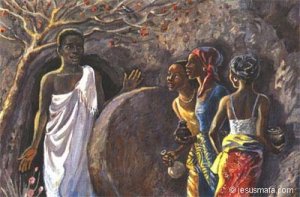
I doubt they slept much the last two nights, the women who rose early on the first day of the week to minister to their dead Lord. Every time they shut their eyes, I’m sure they saw the silhouette of Jesus’ cross in the distance, his limp body all but unrecognizable because of his torturous hours hanging there. And because dead bodies never, ever look like the lives ones they were a moment before; especially Jesus’ body, he who was so full of abundant life that he was just giving of his abundance to anyone who asked. No, I doubt these women slept much, though if they did finally fall into fitful slumber, it was because they cried themselves to sleep. When all you have left is your tears, you’d want to hoard them; but that’s when they flow all the more freely.

"Women at the Tomb" (Jesus Mafa - click for more info)
“Women at the Tomb” (Jesus Mafa – click for more info)

I’m sure the tears began again when they awoke early on the first day of the week. New grief is like that. Each morning you wake and remember again that your loved one is gone, and again the pain stabs you anew, just as fresh as the first time. But even in the midst of their grief, these women took up their burdens of fragrant spices and trudged out into the darkness, so they could arrive at the tomb at first light.

But these brave women, who are ready to care for the body of their Lord, to do their duty out of love and compassion, are making the happiest mistake in the history of mistakes. They are prepared to wash and anoint a lifeless body, but what they find is no body at all. They find an empty tomb, save for a discarded burial shroud. Their grief threatens to overwhelm them because the duty they were planning to perform – the one they had been clinging to since his death – is gone now, too. They didn’t think they could be more desolate, but they were wrong. The empty tomb magnifies their desolation.

But into this scene of despair and grief comes the sudden presence of two gleaming messengers. They enlighten the woman as to their mistake: “Why do you look for the living among the dead? He is not here, but has arisen.” Then they remind the women what Jesus had said about himself while they were all still in Galilee.

The women remember Jesus’ words, and first one, then another, then another breaks out into a tentative smile. “Could it be true?” they ask each other.

“Yes, yes, yes it could.”

“Jesus never lied to us.”

“How could we forget his words?”

Then one repeats the messengers’ question: “Why are we looking for the living among the dead?”

This question echoes down through the centuries, and we find ourselves asking it when we read the beginning of the final chapter of Luke’s account of the Gospel. Why do you look for the living among the dead? How often in our day-to-day lives could we hear the gleaming messengers asking us this question? How often do we trudge down the well-worn path to life-defeating things hoping this time – maybe this time – something life-affirming will happen?

Perhaps you’ve had a string of boyfriends who were real losers. Your friends tell you so at every opportunity, but you’ve got a blind spot for bad boys. They treat you with no respect. From time to time they’ve even called you a name that I can’t say during this sermon. And yet you meet another one and all the signs are there, but you dive in headfirst anyway. To you the gleaming messengers say, “Why do you look for the living among the dead?”

Perhaps you’ve been sober for three months. Your sponsor hands you your chip and slaps you on the back. You’ve got a couple of other three-month chips in a drawer somewhere, but that’s not on your mind right now. On your way home from the meeting, you run into an old buddy from back in the day. The next morning, you stagger to the drawer and toss the newest chip in. Maybe you’ll get another one in a few months time. To you, the messengers say, “Why do you look for living among the dead?”

Perhaps you work through your family vacation because you’ve got too many projects on your plate. Or you spend every waking hour mindlessly surfing YouTube and Facebook. Or you derive your self-worth only by what others say of about you. To you – to all of us – the messengers say, “Why do you look for the living among the dead?”

The Resurrection of Jesus Christ spurred this question all those centuries ago. The women made the happy mistake of looking for a dead Christ, when the Risen One was alive again. They brought to the tomb their grief, their tears, and their emptiness. And they left them there because the power of the Risen Christ outshone any desolation left in them.

When we look for life-affirming answers in the midst of life-defeating things, we replicate the women’s happy mistake, but with none of their good intentions. When we look for the living among the dead, we are trudging the well-worn path to the newly hewn grave where a dead messiah awaits. That way is full of tears and lifelessness.

But the good news of the Resurrection is this: when we arrive at the tomb, at rock bottom, at the ends of our ropes, we will find the Living Christ shining radiantly in the midst of our dead messiahs. We will find his empty tomb, which is ready to receive all of our muck, all of our bad choices, all of our life-defeating tendencies. When we deposit all of our dead ends there, we can leave the tomb unencumbered, and chase off after the Risen Christ, fresh, free, and born anew.

So why do you look for the living among the dead?

He is not here, but has arisen.

Therefore, Go (April 30, 2012)

This is the final Devo of the 10 part series from the last few weeks. It got pushed to today because I had a glitch last Monday that through everything off by one day. We’ll be back on track tomorrow. –Adam

…Opening To…

A marvelous and mighty paradox has thus occurred, for the death which they thought to inflict on Him as dishonor and disgrace has become the glorious monument to death’s defeat. (St. Athanasius)

…Listening In…

Now the eleven disciples went to Galilee, to the mountain where Jesus told them to go. When they saw him, they worshipped him, but some doubted. Jesus came near and spoke to them, “I’ve received all authority in heaven and on earth. Therefore, go and make disciples of all nations, baptizing them in the name of the Father and of the Son and of the Holy Spirit, teaching them to obey everything that I’ve commanded you. Look, I myself will be with you every day until the end of this present age.” (Matthew 28:16-20; context)

…Filling Up…

Today is the last day of our ten day look at Jesus’ Resurrection appearances. We close as Matthew does, with Jesus’ final words in the Gospel. Notice that his very last words: “I will be with you every day,” echo the name that the angel Gabriel gives to him: Immanuel, which mean “God with us.” Thus, God’s presence bookends the Gospel – that’s pretty cool.

But leaving that tidbit, let’s talk about the word “therefore.”

Matthew’s account of the Gospel comes to a close, Jesus says the above words to the disciples. By the power, by the authority of Jesus, the disciples are sent out. And by the work of the disciples down through the centuries empowered by Christ, we too hear these words, we too are sent out. Jesus’ authority spurs us to go, make, and baptize. Indeed, Jesus is the author, the source of our going, our making, and our baptizing.

Scholars call this the “Great Commission,” and within this commission is also great warning. Jesus says, “Therefore, go.” The therefore makes our commissioning contingent on recognizing that everything we do because of God’s call in our lives generates from the authority given to Jesus. The day, the hour, the minute we start to think that we are ministering to people by our own authority is the time we need to take a step back, fall to our knees, and ask God for forgiveness. Paradoxically, the better we get at following Jesus, the easier we fall into the trap of failing to recognize the authority of Jesus prompting and empowering our actions.

But when we come to God in prayer or when we come to the table to receive communion, we come with empty hands and dry mouths. We come reminded that our gifts, like the gifts of bread and wine, have their source in God alone. We come not trusting in our own righteousness, but in God’s manifold and great mercies. As the body and blood of Christ nourish us, the power and authority of Christ compel us to go, make, and baptize; to trust, hope, and believe; to love, serve, and proclaim.

So go out and by your love and your loving witness, make disciples – and remember that Jesus is with you always, to the end of the ages.

…Praying For…

Dear God, I was with you while I was still in my mother’s womb and I will be with you when I pass through death into new life. Help me to remember that your presence abides in my life, and help me act out of that knowledge every day. In Jesus Christ’s name I pray. Amen.

…Sending Out…

I leave this moment with you, God, rejoicing that you raised your Son from the dead and showed me that nothing in all of creation can separate me from your love.

Two Witnesses (April 27, 2012)

…Opening To…

A marvelous and mighty paradox has thus occurred, for the death which they thought to inflict on Him as dishonor and disgrace has become the glorious monument to death’s defeat. (St. Athanasius)

…Listening In…

With great fear and excitement, they hurried away from the tomb and ran to tell his disciples. But Jesus met them and greeted them. They came and grabbed his feet and worshipped him. Then Jesus said to them, “Don’t be afraid. Go and tell my brothers that I am going into Galilee. They will see me there.” (Matthew 28:8-10; context)

…Filling Up…

Today is the second to last day of our celebration of Jesus’ post-Resurrection appearances, and today we move to the Gospel according to Matthew to wrap up. Right before the verses above, the women have gone to the tomb and found the stone rolled away. An angel tells them: “Don’t be afraid. I know that you are looking for Jesus who was crucified. He isn’t here, because he’s been raised from the dead, just as he said. Come, see the place where they laid him. Now hurry, go and tell his disciples, ‘He’s been raised from the dead. He’s going on ahead of you to Galilee. You will see him there.’ I’ve given the message to you.”

And then the women hurry away to tell the disciples, but they run into Jesus instead. And he says almost the exact same thing the angel did a minute before. So, why the repeat dialogue? Why have the angel’s monologue and Jesus’ repetition so close together? Could it possibly be because what they told the women is so incredulous that they needed to hear it twice? Perhaps, the readers of the Gospel needed a “come again” moment. Didn’t quite catch that the first time. Come again?

Or perhaps Matthew is playing by the rules that he sets on Jesus’ lips ten chapters before. Jesus says, “If your brother or sister sins against you, go and correct them when you are alone together. If they listen to you, then you’ve won over your brother or sister. But if they won’t listen, take with you one or two others so that every word may be established by the mouth of two or three witnesses” (Matthew 18:16-17).

Matthew uses the angel’s and Jesus’ testimony as proof of the Resurrection that would essentially hold up in court (the two witnesses thing). The thing is – they might have been the first to declare the Resurrection, but they certainly weren’t the last. God calls us to be witnesses to the Resurrection even now.

…Praying For…

Dear God, your Son rose from the dead to show us that death would never again have power over us. Help me to proclaim the grace of the eternal relationship that you yearn to have with each of us through the power of the Resurrection. In Jesus Christ’s name I pray. Amen.

…Sending Out…

I leave this moment with you, God, rejoicing that you raised your Son from the dead and showed me that nothing in all of creation can separate me from your love.