
Biblical scholars have an especially silly sounding word they use for “passage from the Bible.” It is pericope, and if you type this into Microsoft Word, Bill Gates will try to change the word into periscope, 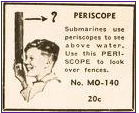 because (apparently) the latter is much more frequently used. ‘Pericope’ may look like a three-syllable word (like periscope without the ‘s’), but it has four syllables and rhymes with calliope.* If you are at a Bible study and drop the word ‘pericope’ your companions will probably stare at you and wonder how you got your hands on the Anchor Bible Commentary.
Pericopes are important because they define the amount of text you are going to study. The word is a mash-up of two Greek words meaning “to cut around,” so when you pick a pericope you are figuring out how much text you want to swallow at one go. If you pick too little, you may be in danger of ignoring the context of the bit you pericopized.** If you pick too much, getting your head around it all may be a difficult task. (SPORTS ANALOGY ALERT) Think of it like this: American football games (and for that matter real football games) are time-constrained. The viewer knows just how long a regulation-length game will be. This makes the last few minutes exciting.*** Conversely, cricket (a sport only comprehensible if you were born in a Commonwealth country) can go on for three or four days–though I’m convinced most of that time is spent making crumpets and talking about the weather.
Okay, so how do you choose a pericope? First, I wouldn’t take more than about twenty verses. The fewer the verses, the more in-depth you can go, though I’d probably put a minimum at around four or five. If you’re Bernard of Clairvaux you can write a treatise on a single instance of a word in the Bible, but you’re not, so don’t. If the story you are reading is longer than twenty verses, focus on a particular section of the story each session until you’ve covered the whole thing. It is amazing what you can discover about God in just a few verses of the Bible; if you bite off more than you can chew, you’re likely to miss something exciting and revelatory.
Second, don’t be swayed by chapter breaks or section headings. The chapters were added in the late middle ages and the headers by the publisher of your particular edition of the Bible. Needless to say, neither is original to the text. Now, the chapters usually do a pretty good job breaking up the text, but they aren’t batting a thousand.**** For example, most scholars identify a large pericope from John 15:1 to 16:4a, so the chapter break is misleading. As for the headers, if it were up to me, I’d tell you just to go out and buy a Bible without them (like this one). While they are handy if you are looking for a passage, they often serve to sway a reader’s interpretation before she even gets to the text.
Third, look for transitional words like “immediately” or “the next day.” Mark uses the word immediately about 579 times, and it often serves to signal a new section. Actually, he uses it 41 times, but that’s still 2.5 times a chapter, which is a lot.
Fourth (and this can be a bit tricky when reading in translation) look for any literary structures the writer is employing in a particular section. For example, if the writer uses the same three words to begin three consecutive sentences, they are more than likely related. (This is call anaphora). We’ll talk about some of these structures in later posts, but for now, if you see one in action, you’ve identified a pericope!
Honestly, though this is an important step in biblical study, choosing pericopes is usually really easy because the biblical writers are really good at what they do. And modern scholars spend way too much energy and way too many pages in their commentaries quibbling over whether this verse goes with this or that pericope. If you take one thing away from this post, remember that choosing a pericope is like eating a healthy serving size. Too little and you’ll still be hungry. Too much and you will have gorged yourself to the point of not remembering everything you ate. Choose a portion you can chew and digest. Let the passage of the Bible fill you. Let the words of the Bible nourish you. And let God encounter you every time you pick up the book for study.
Footnotes
* (1) That strange little organ-like instrument they use in the circus or (2) the Greek muse of epic poetry, who is probably a bit miffed that we now use her name to identify a strange little organ-like instrument they use in the circus.
** I just made up this word, so please don’t use it if you are writing anything a professor will see. Remember, professors think they are the only ones allowed to make up words.
*** You may be quick to point out that the last 2 minutes of American football games take a half hour to play. Good point. My mother makes the same one when she calls my father and me up for dinner and we say there’s two minutes left in the game.
**** Sorry, I forgot to warn you about that sports metaphor.
 Where the Wind...