You are my Beloved

 (Sermon for Sunday, January 13, 2013 || Epiphany 1C || Luke 3:15-17, 21-22)
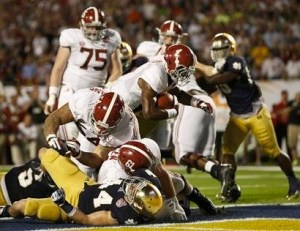
tide2013Last Monday evening, I sat down to watch a very entertaining football game. Now, I know up here is Pats’ country, so many of you probably didn’t even realize the college football championship game was going on. But I grew up in Tuscaloosa, Alabama, so I was ready for my Crimson Tide to take it to the Notre Dame Fighting Irish. (Which they did, by the way.) Because I was watching a live sporting event, I didn’t have the opportunity to fast forward through the commercials. One commercial aired several times, and I became more and more uncomfortable every time I watched it.

The commercial is for a new smartphone, the “Droid DNA.” The thirty-second spot begins with a man being strapped to a chair. A lab-coated technician secures the phone to the man’s chest, and over the thirty seconds of the commercial, the phone “rewrites” the man’s DNA. A mechanical voice announces that the man’s “neural speeds” are increasing and his brain is upgrading to a “quad-core processor.” At the end of the commercial, a voiceover says, “Introducing Droid DNA by HTC. It’s not an upgrade to your phone, it’s an upgrade to yourself.”

Now, perhaps I was uncomfortable with the idea of a phone taking the place of my brain because ever since I wrote Digital Disciple I have been fighting this tendency tooth-and-nail. Or perhaps I was uncomfortable because by the end of the commercial, the man looked like one of the Borg on Star Trek. These two surely played a part. But I think I was uncomfortable mostly because the commercial let me know something about myself that I didn’t know before. According to the commercial, I am due for an upgrade. I am deficient in some way, and only the Droid DNA smartphone will make up for that deficiency.

This is how marketing campaigns work. They tell us ways we are defective, and then they try to sell us products designed to improve those defects. Truck commercials tell men they aren’t manly unless their vehicles can haul a couple tons of dirt. Toy commercials tell kids they won’t be happy unless they receive the hot new toy for Christmas. And don’t get me started on commercials aimed at women. Judging by the ads, women in this country have hair that isn’t shiny enough; bodies that aren’t the right shape; the wrong handbags, clothes, shoes, and earrings; too many wrinkles; and not enough diamonds.

All this must be true, right? I mean, we are bombarded with our supposed deficiencies everywhere we turn: the TV, magazines, Internet ads, the sides of buses. Then we repeat them over and over again until they seem like truth. And pretty soon, it’s not just the marketers, but everyone getting in on the fun. And that’s when the boy feels deficient because he hasn’t played the video game all his friends are talking about. That’s when the girl feels defective because she doesn’t quite fit the clothes her friends have started to buy. That’s when the parents feel substandard because they can’t afford the tuition at the “best” college. At one point or another, our society as a whole started believing in our supposed deficiencies, hence why Americans aren’t very happy people.

But we have been deceived.

Today’s Gospel reading uncovers the deception and offers the supreme truth that has the potential to scrub away all the battering our self-esteem has taken over our supposed deficiencies.

At the beginning of his ministry, Jesus is baptized. After he rises from the water, he prays, Luke tells us, and the heavens open. And the “Holy Spirit descends” on Jesus in “bodily form like a dove.” The voice of God speaks from heaven: “You are my Son, the Beloved; with you I am well pleased.”

Now, you might be wondering what these words have to do with counteracting our supposed deficiencies. After all, God is talking to Jesus, not to us, right? Of course, God would be well pleased in Jesus, who has no deficiencies.

Ah, yes, we who have been programmed to think of ourselves as hopelessly deficient beings wouldn’t possibly presume to think that God might be talking to us as much as God is talking to Jesus. But we would be wrong.

Remember that the Holy Spirit descends on Jesus like a dove. This same Spirit dwells within each one of us, animating us and speaking life into our souls. Thus, we are connected to the God who spoke those words to Jesus. But we are not just connected to God. Hear what Paul says to the church on Rome: “For all who are led by the Spirit of God are children of God. For you did not receive a spirit of slavery to fall back into fear, but you have received a spirit of adoption. When we cry, ‘Abba! Father!’ it is that very Spirit bearing witness with our spirit that we are children of God, and if children, then heirs, heirs of God and joint heirs with Christ” (8:14-17).

Not only are we connected to God, we are God’s children, and not only God’s children, but heirs right alongside Jesus. So God’s words at Jesus’ baptism are not just for Jesus. They are for us, as well. You are my son. You are my daughter. You are my beloved. With you I am well pleased.

With you I am well pleased. Notice that God loves Jesus, God is pleased with Jesus, even though Jesus has done nothing yet to earn God’s love and pleasure. At this point in Luke’s Gospel, we are at the very beginning of Jesus’ ministry. All of his miracles, his sermons, his death and resurrection – they are all ahead of him. Before any of that happens, God showers upon him God’s love and pleasure.

Likewise, you and I who are joint-heirs with Christ have never done anything in our lives, nor will we do anything in our lives, to earn God’s love and pleasure. They are ours intrinsically. They are ours because we are God’s. And because we cannot earn God’s love and pleasure, we cannot do anything to lose them either. They are part of what makes us who we are – the best part of what makes us who we are.

At Jesus’ baptism, God took the opportunity once for all time to tell all of God’s children that we are loved and that we are a delight to God. We can ignore these fundamental truths. We can choose to think they don’t apply to us. But we cannot undo them, no matter what.

That God chose Jesus’ baptism in the River Jordan as the opportunity to reveal these truths to us is simply wonderful. What is the one thing in this world that is more prevalent than advertising targeted at our supposed deficiencies? That’s right. Water.

So the next time you take a shower, the next time you wash your hands, the next time you take a drink or get stuck in the rain, I invite you to feel the water touch your skin. Remember your own baptism. Remember that all of our supposed deficiencies, which teach us to think we are defective or substandard, are no match for the fundamental truth that God has built into the fabric of life. You are God’s children. You are God’s beloved. And with you, God is well pleased.

In Your Very Skin (January 11, 2013)

…Opening To…

Just like a deer that craves streams of water,
my whole being craves you, God.
My whole being thirsts for God, for the living God. (Psalm 42:1-2a)

…Listening In…

“Your mother died to save you. If there is one thing Voldemort cannot understand, it is love. He didn’t realize that love as powerful as your mother’s for you leaves its own mark. Not a scar, no visible sign… to have been loved so deeply, even though the person who loved us is gone, will give us some protection forever. It is in your very skin.” (Albus Dumbledore, Harry Potter and the Sorceror’s Stone)

…Filling Up…

We have come to the final day of our first Harry Potter week on devo180. And no week about the first book would be complete without a discussion of the sentences above. Read from the perspective of a follower of Jesus, Dumbledore’s words about love drip with the power of the resurrection. In a sense, we know that resurrection is real because the love we have for those who have died doesn’t go away. True love is never one-sided. So when our love lingers for a deceased loved one, then we can be sure the love of that person lingers as well. How could it possibly if the person is dead?

All love is held in trust by God. Whether we acknowledge it or not, all love passes through God because all love is of God. Our deceased loved ones are even closer to God’s presence than we are because of the power of the resurrection. And therefore, their love for us still matters in our lives.

Dumbledore doesn’t speak in such theological terms, but J.K. Rowling, it seems to me, illustrates this understanding of love through the image of Lily Potter’s loving, self-sacrificial protection of Harry. Her love for him lingers in his very skin. Voldemort doesn’t understand this (what C.S. Lewis might have called a part of the deeper magic from before the dawn of time). Voldemort is obsessed with cheating death, so he never seeks to understand that there is a power beyond death that one can only access once one has passed through death’s gate.

Harry’s mother’s love does not evaporate when she dies. Instead, it “leaves its own mark.” It’s an invisible mark, though Harry seems to think Dumbledore means Harry’s scar. This mark resonates for me with the scene in the Gospel when the resurrected Jesus invites Thomas to touch the marks that Jesus’ own self-sacrificial love has made. Lily’s love illustrates Christ’s. Later in the series, Harry will follow the same path. But that love lingers in our very skin. And this is how we know resurrection is real.

…Praying For…

Dear God, you are love, and I am only able to love because you desire me to have the capacity. Help me to love others with the unselfish love of your Son, Jesus Christ, in whose name I pray. Amen.

…Sending Out…

I leave this moment with you, God, glad to know that, even though I am a muggle, you still weave your magic through my life.

Destroying the Stone (January 10, 2013)

…Opening To…

Just like a deer that craves streams of water,
my whole being craves you, God.
My whole being thirsts for God, for the living God. (Psalm 42:1-2a)

…Listening In…

“You know, the Stone was really not such a wonderful thing. As much money and life as you could want! The two things most human beings would choose above all – the trouble is, humans do have a knack of choosing precisely those things that are worst for them.” (Albus Dumbledore, Harry Potter and the Sorcerer’s Stone)

…Filling Up…

Albus Dumbledore sure has the measure of the human race. Near the end of the first Harry Potter book, Dumbledore and Harry are talking about the Sorcerer’s Stone. Nicholas Flamel, the owner of the Stone, and Dumbledore decided to destroy it rather than risk it being stolen and used for malevolent purposes.

This was the best decision they could make considering the lengths Voldemort goes to get the Stone. I assume Dumbledore wished that he had made such a decision long before – destroy the Stone, rather than hide it. But Dumbledore knows better than most that “humans…have a knack of choosing precisely those things that are worst for them.”

He’s right, of course. But why do we make life-negating choices when we could make life-affirming ones? What is it about our makeup that propels us down the paths to destruction? As followers of Jesus Christ, we strive to walk behind the One who is on the right path precisely because we know that if we weren’t following so closely, we’d go astray – like sheep without a shepherd.

The choice we have to continue making, then, over the course of our entire lives, is a simple one. (A simple choice, but with great consequences.) That simple choice is between following Christ and not following Christ. We have to make that choice every day because every day we are tempted to make an easier choice, which is to follow where are own footsteps lead. This is an enticing option because it’s a path of lesser resistance and it will seem exciting for a time.

But it is not the path of life. Dumbledore has the measure of us, all right. But by reaffirming every day our commitment to following Christ, we can practice choosing the things that are best for us. And with God’s help, perhaps we will, over time, counteract that fundamental human failing.

…Praying For…

Dear God, your Son is ever walking one step before me. Help me to see his footprints ahead of me in my life, so that I may always choose to follow him. In Jesus Christ’s name I pray. Amen.

…Sending Out…

I leave this moment with you, God, glad to know that, even though I am a muggle, you still weave your magic through my life.

Through the Trapdoor (January 9, 2013)

…Opening To…

Just like a deer that craves streams of water,
my whole being craves you, God.
My whole being thirsts for God, for the living God. (Psalm 42:1-2a)

…Listening In…

“We’ve had Sprout’s, that was Devil’s Snare; Flitwick must’ve put charms on the keys; McGonagall transfigured the chessmen to make them alive; that leaves Quirrell’s spell, and Snape’s…” (Hermione Granger, Harry Potter and the Sorcerer’s Stone)

…Filling Up…

The climax of the first Harry Potter book finds the three heroes – Harry, Ron, and Hermione – past Fluffy, the three-headed guard dog, and down the trapdoor. To reach the Sorcerer’s Stone, they must defeat the barriers put up by the Hogwarts teachers. Several of the teachers have lent their expertise to protecting the stone, so each barrier tests a different strength of each of the heroes. What’s wonderful about this series of challenges is the fact that any one of the heroes would not have been able to make it to the stone alone.

Hermione remembers that Devil’s Snare likes dim and damp places, but she forgets that she can conjure fire from her wand until Ron reminds her. In the key room, Harry’s prowess as a Quidditch seeker comes in handy as he tracks down the right flying key. Ron is the only one who is good at chess, so he plays and wins the living chess match. Hermione’s logical mind solves the riddle of the seven bottles. And Harry bravely stands up to Quirrell and Voldemort at the end of the line.

Harry, Ron, and Hermione use the special gifts each has to get past the barriers. One alone would not have made it but together they succeed. They are better together. While Harry always seems to end up alone at the end of each book, he would never have gotten there without his two best friends.

I am positive J.K. Rowling constructed the challenges at the end of Sorceror’s Stone to highlight the giftedness of each of her heroes and their strength as a team. So my questions are these: what groups, families, communities, and teams do you belong to? What special gifts do you bring to them? How do others in those groups make up for your deficiencies? Where do you see God in your own giftedness and in the giftedness of those around you?

…Praying For…

Dear God, you are the giver of all good gifts. Help me to recognize the gifts of those around me, so that I may discern how my own gifts fit in with those of the people I am blessed to be with. In Jesus Christ’s name I pray. Amen.

…Sending Out…

I leave this moment with you, God, glad to know that, even though I am a muggle, you still weave your magic through my life.

Standing up to our Friends (January 8, 2013)

…Opening To…

Just like a deer that craves streams of water,
my whole being craves you, God.
My whole being thirsts for God, for the living God. (Psalm 42:1-2a)

…Listening In…

“There are all kinds of courage,” said Dumbledore, smiling. “It takes a great deal of bravery to stand up to our enemies, but just as much to stand up to our friends. I therefore award ten points to Mr. Neville Longbottom.” (Albus Dumbledore, Harry Potter and the Sorcerer’s Stone)

…Filling Up…

Day two of our first Harry Potter week on devo180 has come. As the story reaches its climax, Harry, Ron, and Hermione resolve to sneak out of Gryffindor tower to try to stop Professor Snape (Quirrell, really, but they don’t know that yet) from obtaining the Sorcerer’s Stone. They wait in the common room until everyone has gone to bed, and then they move toward the door. But Neville Longbottom (a pitiable character, at least in this first book) gets in their way. He tells them he doesn’t think they should be going out and breaking any more school rules. He stands up to his friends because he thinks he is in the right. And he shows quite a bit of courage doing it.

But Harry, Ron, and Hermione think they are in the right, as well. They need to break a few rules in order to stop Voldemort from returning. What we have here is a classic problem in the field of “ethics.” Sometimes our decisions involve choices between right and wrong. Presumably, these are fairly easy choices to make: you make the right one because the wrong one is, well, wrong. It would be like saying 2 + 2 = 5. (The black and white nature of right/wrong choices doesn’t stop people from choosing the wrong option, of course, but that’s another matter.)

More often than not, however, our choices are not between right and wrong but between right and right. In our example from Harry Potter, both Neville and our heroic trio are in the right: Neville wants them to obey the rules, and they want to stop Voldemort. So which would you choose? I imagine we would all say, “Stop Voldemort.”

But that doesn’t make Neville’s alternative any less valid. (In books 5 and 7, by the way, Neville is the poster child for breaking rules in order to fight Voldemort.) His example in the first book reminds us that our decisions often have more than one right answer. These choices are so much harder to make than the ones with a right and a wrong answer. So my questions for you are these: when is the last time you can remember deciding something that had more than one right answer? What guided your decision-making?

…Praying For…

Dear God, you are the source of all truth in my life. Help me, whenever I am confronted with a decision, to choose the option that most aligns with your desires for me. In Jesus Christ’s name I pray. Amen.

…Sending Out…

I leave this moment with you, God, glad to know that, even though I am a muggle, you still weave your magic through my life.

The Mirror of Erised (January 7, 2013)

…Opening To…

Just like a deer that craves streams of water,
my whole being craves you, God.
My whole being thirsts for God, for the living God. (Psalm 42:1-2a)

…Listening In…

“It does not do to dwell on dreams and forget to live, remember that.” (Albus Dumbledore, Harry Potter and the Sorcerer’s Stone)

…Filling Up…

We begin the year 2013 of devotiONEighty with the first of seven Harry Potter weeks. I don’t know when the other six will be, but we’ll have one from time to time. This week, we will focus on the first book, Harry Potter and the Sorcerer’s Stone (more properly known as the Philosopher’s Stone in its native Britain). We’ll look at quotations and themes and see how this excellent work of modern fiction can help us as we seek to follow Jesus Christ.

I assume my readership has read the Harry Potter books because most people have. If you haven’t, consider this week of devos a call to pick up the series. You won’t be sorry.

About two-thirds of the way through the first book, Harry discovers the Mirror of Erised. As “Erised” is a reflection of the word “Desire,” you won’t be surprised to know the mirror shows the viewer his or her deepest yearning. In it Harry sees his parents, who were killed when we was a baby. Harry goes back again and again and just stares into the mirror, longing to be with those whom he had lost.

Professor Dumbledore finds him and tells him the mirror will be moved to a new home. And then the headmaster speaks the line above: “It does not do to dwell on dreams and forget to live.” Dreams are wonderful things, of course. Dreams propel us to think of our lives in the big, wonderful way that God sees them, unbounded by what we think is possible. But Dumbledore has seen the other side of dreams. He has known people who have “wasted away before [the mirror], entranced by what they have seen.” These dreamers sunk into their dreams and forgot to live, as Dumbledore says.

How often do we forget to live? What keeps us from living the kind of lives that God desires us to live? What gets in the way? These are questions that the Mirror of Erised brings up. Another is this: what do you think you would see in the mirror? Is it the kind of dream that you think God yearns for you as much as you yearn for it?

…Praying For…

Dear God, your desires for me make up the deepest layer of my call as a human being. Help me to tune myself to your desires so I may always remember to dream your dreams and never forget to live. In Jesus Christ’s name I pray. Amen.

…Sending Out…

I leave this moment with you, God, glad to know that, even though I am a muggle, you still weave your magic through my life.

Magnify the Lord

(Sermon for Sunday, December 23, 2012 || Advent 4C || Luke 1:39-55)

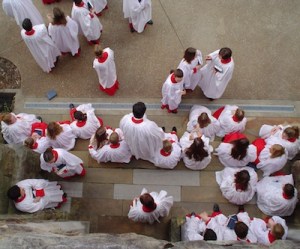
choirWhen I was in college, I never had time to watch TV or play sports or go on wild spur-of-the-moment car trips. I was too busy singing. The University Choir rehearsed four times a week and sang every Sunday morning during the church service. When I joined freshman year, I could barely piece two correctly pitched notes together, but the choir director, God bless him, would take anyone who was willing, including me. Four years and hundreds upon hundreds of hours of singing later, my voice managed to match pitch most of the time, and hey, it didn’t sound too bad.

The choir spent more time on one particular song than any other, a song that has found a special place in my heart. We sang the song once a month at the service of Choral Evensong, and every month we sang a different arrangement. But each arrangement had the same words, and those words always began with “My soul doth magnify the Lord, and my spirit hath rejoiced in God my Savior.”

These are the opening lines of Mary’s song, the Magnificat. We always sang them with the Elizabethan translation (with all the doths and haths) because the best musical versions are set to the old text. I must have sang 20 or 25 different settings during my time at Sewanee, and with each one, a single image from this opening line delved into me and settled deep within. I’d like to share that image with you this morning.

“My soul doth magnify the Lord,” sings Mary. What happens when you use a magnifying glass, like a microscope, perhaps? Say we are back in freshman biology lab and the instructor passes around a tray of slides. You and I (you all are my lab partner for this illustration, by the way)…You and I take one of the slides and pass the tray on to the group beside us. Next you take our pipette and squeeze one tiny drop of clear liquid onto the slide. We hold the slide up to the light and squint. We see nothing but a bit of water on glass.

But then I place the small pane of glass underneath the microscope, and you put your eye to the lens. You click into place the scope marked “30x magnification” and fiddle with the focus dial.  And what was a moment ago just a drop of clear liquid is now a squirming mass of single-celled organisms, each dancing and stroking its way through the ocean that is the drop of water. How could we miss so much life happening in miniature? How could we ever think the drop of water was simply empty, clear liquid?

When we magnify, we take something difficult to see, and we make it more visible. “My soul doth magnify the Lord,” sings Mary. Mary’s soul is the magnifying lens, and she trains her soul on the God who has blessed her with the Christ in her womb. This brings up two questions. First, if God is so big, then why does God need magnification? Second, what is this “soul” Mary uses as her magnifying glass?

Well, to answer the first question, I’ll admit the whole microscope metaphor breaks down when we bring God into it. But the need for magnification persists because, let’s face it, sometimes God is hard to see. How many of us have ever had a time when we looked for God and found next to no evidence of God’s presence? How many of us have cried out to God and felt like our cries have fallen on deaf ears? This past week, in the wake of the Newtown shooting, how many of us have asked the question, “Where is God in all of this?”

It’s so close, so raw that we have no answer for this question—at least, not right now. We have only glimpses. We can only catch God out of the corner of our eye. We can only nibble around the edges of sense. In a month or two, or in a year or ten, I have hope that we will look back on this week and say, “Oh, that’s where you were, God. You were right there all along.” But right now, we have trouble seeing God. And so we need magnification. “My soul doth magnify the Lord,” sings Mary.

The soul is our magnifying glass, which begs the question: what is the soul? Now, this question is a whole other sermon – or possibly a multi-volume dissertation – so we’ll be brief. Please excuse the poetic language I’m about to employ – poetry is really the only way to speak briefly of such things as the soul.

Our souls are the places within us that are continually in contact with God, whether we are aware of the connection or not. The constancy of this connection happens because the soul is the piece of eternity around which God shapes each one of us. Each piece of eternity resonates with the eternal nature of God. The nature of God is also creative, which is why each piece of eternity comes wrapped in a unique, newly created person. The soul, then, is the deepest part of us, the one that makes us who we are and the one that connects us to God. This soul is the lens for our magnification. “My soul doth magnify the Lord,” sings Mary.

When Mary sings this, she signals both her joy that she is in God’s midst and also her willingness to partner with God to make God more fully known. God could easily be fully and visibly present to each of us all the time, but I wonder if the reason God is not lies in God’s desire to make our souls resonate even more fully with God. This resonance happens when we participate in God’s act of making God known, when we make God visible to other people, when we magnify the Lord.

Because the soul is the piece of each of us where our individuality resides, God has given each of us a unique way to magnify God’s presence. Perhaps yours is your passion for ministry with people who have no homes. Perhaps yours is your devotion to your children’s wellbeing. Perhaps yours is your singing voice or your ability to listen to other people’s fears or your overwhelming capacity to see the goodness in all people. Each of these gifts rises up from the cores of our beings, from our souls, and through them we magnify the Lord.

So in the next couple of days, as we celebrate the Incarnation of God’s greatest gift to us, the birth of our Lord Jesus Christ, I invite you to spend some time in conversation with God and perhaps also with a trusted confidant. Ask how your own particular soul might best serve to magnify the Lord. Ask what special gift God packaged with your own unique piece of eternity. Ask how your life can be a reflection of Christ’s Incarnation.

“My soul doth magnify the Lord,” sings Mary. So do each of ours. Thanks be to God.

Treasure (December 21, 2012)

…Opening To…

God’s glory, now, is kindled gentler than low candlelight
Under the rafters of a barn:
Eternal Peace is sleeping in the hay,
And Wisdom’s born in secret in a straw-roofed stable. (Thomas Merton)

…Listening In…

When they saw this, they reported what they had been told about this child. Everyone who heard it was amazed at what the shepherds told them. Mary committed these things to memory and considered them carefully. The shepherds returned home, glorifying and praising God for all they had heard and seen. Everything happened just as they had been told. (Luke 2:17-20; context)

…Filling Up…

The first question, which these final verses of our story brings, is this: to whom did the shepherds report? I’m really curious. Did they run through Bethlehem Paul Revere style (“The messiah is coming! The messiah is coming!”)? Did they go to the local census bureau (after all, that’s why Mary and Joseph were in Bethlehem in the first place) and tell them to add another Israelite to the rolls? Did they go to the religious leaders and tell them that their hopes had been fulfilled?

Without answering this question, I’ll pose another: what kind of reaction did the shepherds receive? Luke tells us that everyone who heard their report was “amazed at what the shepherds told them.” But “amazed” is neither a positive nor a negative word. I can be amazed at an acrobatic catch in a football game or at how horrible the food is at a restaurant. I suspect that the shepherds received quite a few responses that went along the lines of: “That’s amazing; ridiculous, but amazing.” Others probably said, “Get off my stoop, you mangy shepherd.”

In the end, we are privy only to one response, and that is Mary’s. She commits the shepherds’ news to memory and considers it carefully. Another translation renders this as “Mary treasured all these things and pondered them in her heart.” Think about it. Mary has just given birth to the Son of God. For nine months, since the angel appeared to her on that fateful day, she has carried the Incarnate Word within her, the physical embodiment of God’s good news to the world. Then she delivers him. But is her body now void of this Word? Thanks to the shepherds, no. They bring the first message of the Gospel back to Mary and she fills herself with the good news again.

Each of us bears the Gospel inside of us. The good news of Jesus Christ is treasure hidden in our hearts waiting to be shared. So go out and proclaim with the shepherds. Glorify and praise God because Christ is born.

…Praying For…

Dear God, you have given me the gift of pondering in my heart the call you have placed within me. Help me to discover that call and move it from its interior resting place to its active phase in my life. In Jesus Christ’s name I pray. Amen.

…Sending Out…

I leave this moment with you, God, as living vessel for holding the light of your son, as was the manger on that holy night.

The Divine Comedy (December 20, 2012)

…Opening To…

God’s glory, now, is kindled gentler than low candlelight
Under the rafters of a barn:
Eternal Peace is sleeping in the hay,
And Wisdom’s born in secret in a straw-roofed stable. (Thomas Merton)

…Listening In…

Suddenly a great assembly of the heavenly forces was with the angel praising God. They said, “Glory to God in heaven, and on earth peace among those whom he favors.” When the angels returned to heaven, the shepherds said to each other, “Let’s go right now to Bethlehem and see what’s happened. Let’s confirm what the Lord has revealed to us.” They went quickly and found Mary and Joseph, and the baby lying in the manger. (Luke 2:13-16; context)

…Filling Up…

Yesterday, we talked about the shepherds being unlikely people for God to confide in. They were the ancient world’s equivalent of the guitarist-whose-band-is-really-about-to-explode-if-they-just-get-their-act-together whom you brought home to mom and dad. They were looked on with suspicion by the city-dwellers, but even with that cloud above them, they were also something besides outcasts.

They were normal. They were just normal guys who happened to look after flocks for a living. This brings me to a wondering question about the verses above. I wonder what exactly they saw when they came upon Mary and Joseph and the baby Jesus. I wonder this because, even with the pronouncements about his fate and parentage and divinity, Jesus was human, as well. He was just a baby lying in an irregular crib. His mother was no doubt wracked from labor, but also filled with joy at the safe delivery of her son. His adoptive father was no doubt alternating between worrying about the comfort of his fiancée and comparing the impossibly small fingers of the infant to his own.

Into this scene, the shepherds burst. Can you imagine a grungy garage band of complete strangers busting into the delivery suite at a hospital? Well, that’s about what happened, except it was a barn since delivery suites were a few millennia from construction (not to mention garages). If the scene weren’t shrouded in both the gossamer of mystery and the wool of tradition, it would be comical.

Indeed, it is comical – in the academic sense of the word (a surprise conclusion that subverts expectations (I just made that up, by the way, but it sounds academic, right?)). In this scene, we are witness to the punch line of a divine joke. But remember what Paul says about God’s comedy. “The foolishness of God is wiser than human wisdom.” The messianic expectations of the people of Israel looked for a military savior with a strong jaw and lots of chariots. What they got was a baby with impossibly small fingers.

…Praying For…

Dear God, thank you for the gift of your Son. Help me to look for him in surprising places where I do not expect to find him. In Jesus Christ’s name I pray. Amen.

…Sending Out…

I leave this moment with you, God, as living vessel for holding the light of your son, as was the manger on that holy night.