The Good Parts Version (Jan. 22, 2013)

…Opening To…

No man ever believes that the Bible means what it says: He is always convinced that it says what he means. (George Bernard Shaw)

…Listening In…

Daughter Babylon, you destroyer, a blessing on the one who pays you back the very deed you did to us! A blessing on the one who seizes your children and smashes them against the rock! (Psalm 137:8-9; context)

…Filling Up…

The third thing not to do when you read the Bible is to read only the “good parts.” The practice of selecting only certain parts of the Bible is so widespread that we regularly do it in our churches when we read passages aloud. Sometimes, we edit parts out for brevity, but in many cases, we edit parts out to censor the “bad” stuff in the Bible. Take Psalm 137 for instance, the final two verses of which are quoted above. There’s a good chance you’ve never heard them because they always get edited out in church.

These verses and other difficult passages in the Psalms and elsewhere (the slaughter at Jericho in the book of Joshua comes to mind) make my stomach turn. How can we keep ourselves from excising these parts from our Bibles? How can we integrate even these hard parts into our lives of faith?

Let’s keep Psalm 137 as our example. This psalm is written from a place of desolation and utter grief as the writer remembers the captivity in Babylon. In 586 bce, God’s people in the land of Judah were taken into captivity in Babylon, victims of conquest and expansion; they lost homes and lives and loved ones. The captivity lasted for decades. The writer remembers the sorrow and hopelessness of those years, in which the captors mocked the people, commanding them to sing their old songs. The writer grieves the loss of Zion, vows never to forget Jerusalem, and then rages at the Babylonian captors.

But the writer expresses rage in the context of a prayer to God. The writer gives the grief and rage to God because they are unbearable. If we remove this passage from our Bibles because it is difficult, we may never discover that God is available, able, and willing to bear our grief and rage. We may never realize that those feelings are natural. If the passage remains, however, we will know that we may not be able to move past these natural feelings right away. We may not be able to forgive or hope just yet. But God will forgive and hope in our stead until we are ready to move past those feelings. This is just one example why editing the Bible to just the “good parts” is a bad idea.

…Praying For…

Dear God, I pray that I can trust you enough to know that you will be with me as I struggle with the difficult parts of the Bible and will hold them in trust until I am ready to integrate them into my life of faith. In Jesus Christ’s name I pray. Amen.

…Sending Out…

I leave this moment with you, God, trusting that you will grant me the patience to study the Bible slowly and keep my eyes and heart open for your presence in my life.

Fortune Cookie Faith (Jan. 21, 2013)

…Opening To…

No man ever believes that the Bible means what it says: He is always convinced that it says what he means. (George Bernard Shaw)

…Listening In…

God didn’t send his Son into the world to judge the world, but that the world might be saved through him. (John 3:17; context)

…Filling Up…

Last week, we discussed a few things you may not have known about the Bible. Continuing in our Biblical theme, this week we are going to discuss five things not to do when you read the Bible. The practices we are going to talk about lead to (a) poor interpretations of the Bible, (b) ungracious and uncharitable opinions of other people, and (c) misunderstandings both of the texts of the Bible and misunderstandings among people who read the Bible in different ways.

The first thing not to do when you read the Bible is the act of reading it a single verse at a time. As I mentioned last week, the verse numbers were added less than five hundred years ago. They artificially divide texts that were always meant to be read each in its entirety. Bumper stickers, signs at ball games, magnets, and greeting cards that point to or quote a specific verse do a disservice to the rest of the text, from which the verse comes. Take John 3:16 for example. Most folks know what it says: “For God so loved the world…” But do you know John 3:15 or John 3:17? What about the beginning of chapter three, which builds to a climax at 16 and 17 before transitioning into another passage? Reading the rest of the story helps us interpret John 3:16 as a part of a larger dialogue between Jesus and the Pharisee Nicodemus. The verse was never meant to be taken by itself.

When we read verses individually, we run into the tendency of stringing together all of our favorite single verses until we have a fortune cookie faith. The Bible was never meant to be tweeted. The books of the Bible were meant to be heard and read, pored over and digested. Single verses out of context might go down easily, but they will never fill you up.

…Praying For…

Dear God, you infuse the Bible with your presence and give me the opportunity to encounter you whenever I read it. Help me to find the patience to read the Bible as it was written. Help me to resist the urge to boil down the Bible into tiny pieces that are easy to recall but tell little of the story. In Jesus Christ’s name I pray. Amen.

…Sending Out…

I leave this moment with you, God, trusting that you will grant me the patience to study the Bible slowly and keep my eyes and heart open for your presence in my life.

You are my Child

I wrote this song for part of the sermon last Sunday, January 13, 2013. I based it on the line in the Gospel: “You are my Son, the Beloved, with you I am well pleased.” I believe that because we are God’s children by adoption through the Spirit, God says this to us as much as to Jesus. This song is written from God’s perspective, speaking the truth to us that God delights in us always. (See below for the lyrics.)

“You are my Child” Lyrics

You turned away so they could not see you cry;
Maybe tomorrow you’ll stand up to those guys
`Cause they picked you last for the football team
And made so much fun of your lifelong dream
To become a famous scientist some day.
You want to crawl home and go straight to bed
Because of all the hurtful things the bullies said,
And this is when I hope you hear me say:

Chorus:
You are my child, and I love you (yes, I do).
You might not believe me, but still it’s true,
I will never stop delighting in you
`Cause you are my child.

You slip your dress on and then you turn around;
Reflected back, your smile fades to frown.
You look at the models in the magazine,
And you realize you’ll never be a beauty queen
If you have to make your body look that way.
You stare into the mirror for a day or two,
And you can’t see the beauty staring back at you;
This is when I hope you hear me say: (Chorus)

You’ve gone to church on and off for several years,
But you have never quite shaken all your fears.
You’ve always been afraid you’re not good enough;
That’s why you put your faith in so much other stuff,
And feel a hole inside that grows each day.
But look inside and see me filling up that space
And know I long for you to look and see my face,
So raise your eyes, behold me as I say: (Chorus)

You cannot earn my love, nor can you lose it
I give it freely, all you need do is choose it. (Chorus)

27 Pieces (January 18, 2013)

…Opening To…

When you read God’s Word, you must constantly be saying to yourself, “It is talking to me, and about me.” (Søren Kierkegaard)

…Listening In…

From Paul, Silvanus, and Timothy. To the Thessalonians’ church that is in God the Father and the Lord Jesus Christ. Grace and peace to all of you. (1 Thessalonians 1:1; context)*

…Filling Up…

The fourth thing you might not know about the Bible (and again, primarily about the New Testament) is the fact that the 27 texts, which make up the second bookcase of the Bible’s library, are not the only texts that were written because of Jesus in the couple hundred years following his death and Resurrection. There were countless other letters, revelations, sermons, and accounts of the Gospel floating around Greece and Asia Minor in the first few centuries after everyone had to get a new calendar.

The church settled on the 27 we have (bonus points if you can name them without looking!) based largely on three criteria: attribution to a first or second generation follower of Jesus, widespread use throughout the church (so the letters that went viral made it in), and sound theological doctrine. Of course, this last one was open to more interpretation than the first two because the church itself was concurrently attempting to establish sound theological doctrine. (Remember the chicken-and-egg thing from yesterday.) Indeed, folks were skeptical of the Gospel according to John for a long time because some fairly whacky people really loved it. (The church called them “heretics.”) But in the end, the group who set the canon needed this account of the Gospel to settle a dispute with another heretical (but much better funded) group.

My intention here is not to despiritualize the Bible by presenting some of the nitty-gritty pieces of history behind its formation. Far from it. I find great hope in the fact that real, fallible human beings cobbled together such an amazing library of texts about God. Clearly, God was moving in that process. And I firmly believe that God moves in our lives, as well, whether we read the Bible or not. But our reading and our study of God’s movement in the lives of others helps us see and participate in that movement in our lives.

I pray that, if you are not already doing so, you pick up your Bible and read. In doing so, your imagination and your heart will open, and you will be ready for an encounter with God.

…Praying For…

Dear God, you were the constant presence in the lives of those who wrote and compiled the Bible, and you always called them back when they strayed from you. Help me to hear your voice calling me back to you, both in the words of the Bible and in the words you write across the sky of my life. In Jesus Christ’s name I pray. Amen.

…Sending Out…

I leave this moment with you, God, hoping for an encounter with you as I read about your presence in the lives of your people.

* This is first verse of perhaps the very first extant Christian text.

Large Letters (January 17, 2013)

…Opening To…

When you read God’s Word, you must constantly be saying to yourself, “It is talking to me, and about me.” (Søren Kierkegaard)

…Listening In…

Look at the large letters I’m making with my own handwriting! (Galatians 6:11; context)

…Filling Up…

The third thing you may not know about the Bible (and specifically the New Testament) is that it wasn’t compiled into the form we know today until a couple of hundred years after the individual pieces were written. (The Hebrew Scriptures followed a similarly haphazard construction, but it’s much less historically verifiable, so we’ll stick with the New Testament for the purposes of this devotional.)

Beginning in the middle of the first century (perhaps the year 49ce, which is when many scholars think Paul penned First Thessalonians), the authors of what became the New Testament started writing. But they had no idea they were writing the Bible. The individual accounts of the Gospel were used in local churches and perhaps passed around to the surrounding environs. Paul’s letters include things such as Paul bemoaning his own handwriting and asking a friend to get a room ready for him. Nearly three hundred years after Paul disclosed embarrassment about his penmanship, the four accounts of the Gospel, letters from various folk, a sermon, an account of people spreading the good news, and a revelation found places in the “canon” of the church. The canon is the starting lineup of texts that the church decided were the best guiding documents for the church’s future. (These documents also helped to form the church, so you’ll find yourself in a chicken-and-egg quandary wondering which came first.)

I think it is simply wonderful that the folks who wrote the New Testament didn’t realize they were doing so. Somehow, this ignorance of their own importance for the life of the world lends a rawness to their writing. The texts display the whole range of human emotion: fervor and fear, hope and hubris, joy and anger. I wonder how much would have been scrubbed out had they known what their writings would become?

…Praying For…

Dear God, you were with your servants when they wrote because you had touched their lives. Help me to touch the lives of others because you have touched mine. In Jesus Christ’s name I pray. Amen.

…Sending Out…

I leave this moment with you, God, hoping for an encounter with you as I read about your presence in the lives of your people.

Chapter and Verse (January 16, 2013)

…Opening To…

When you read God’s Word, you must constantly be saying to yourself, “It is talking to me, and about me.” (Søren Kierkegaard)

…Listening In…

For God so loved the world that he gave his only Son, so that everyone who believes in him won’t perish but will have eternal life. (John 3:16; context)*

…Filling Up…

The second thing you might not know about the Bible is that the chapter and verse numbers are nowhere to be found in the original texts. The chapter breaks became fashionable in the early thirteenth century (over a thousand years after the last New Testament letter was composed), and the verse separators weren’t added until the mid 1500s, well after the printing press had started churning out Bibles. (Of course, our modern Bibles have many things that the original texts did not have: spaces in between words in the Greek portions and vowels in the Hebrew portions, to name a few.)

So why, you might be wondering, is it important to know that the chapters and verses are not original to the texts? Think about it like this. When you go to the theater and watch a (non-digital) film, the movie projector runs one frame at a time, 24 frames a second. Because the frames flit by so quickly, your eye doesn’t register that each one is a discreet unit, a single snapshot in a line of thousands of other single snapshots. Reading the Bible verse to verse is something like watching a film frame by frame: you get the gist of what’s going on, but it’s certainly not the way it was intended to be watched.

You see, when we give undue weight to the verse separations, we run the risk of taking single verses out of context simply because someone 500 years ago decided that, for convenience, it would be nice to divide the texts of the Bible into smaller units than the chapters. Of course, the verse numbers are great in that they tell you where you are, but that is as far as folks should ever use them.

When the Bible was broken down into individual verses, it became even easier to take a verse out of context and use it to prove a point you are trying to make. This is not a good way to use the Bible. It’s better to let the verses live and breath in their own natural environments — the chapters and books to which they belong. When we encounter our favorite verses “in nature,” as it were, maybe they will encounter us differently than they ever have before.

…Praying For…

Dear God, you gave countless people the grace to be witnesses for you in the texts of the Bible. Grant me that same grace so that I may be a graceful, grace-filled witness today, always proclaiming your love. In Jesus Christ’s name I pray. Amen.

…Sending Out…

I leave this moment with you, God, hoping for an encounter with you as I read about your presence in the lives of your people.

* (the most famous verse taken out of context everyday)

The Library (January 15, 2013)

…Opening To…

When you read God’s Word, you must constantly be saying to yourself, “It is talking to me, and about me.” (Søren Kierkegaard)

…Listening In…

The king went up to the house of the LORD, and with him went all the people of Judah, all the inhabitants of Jerusalem, the priests, the prophets, and all the people, both small and great; he read in their hearing all the words of the book of the covenant that had been found in the house of the LORD. (2 Kings 23:2; context)*

…Filling Up…

The first thing you might not have known about the Bible is that it isn’t a book. I know what you’re thinking: have you ever seen a book before? It looks exactly like a book! It’s true: the Bible is cunningly disguised as a book. A small enough one will fit in your pocket. You could download it on you Kindle. The dusty one in your church sanctuary could be used for bench pressing. I even called it a book yesterday when I mentioned its overwhelming popularity.

But it’s not a book. The Bible is actually a library. Way back when ancient Greek was just normal Greek, people called the Bible “ta biblia,” which happens to be plural. The Bible was not “the book,” but “the books.” Nowadays, we get the Bible in a single, handy bound volume, but when we look at it, we should picture a shelf of books rather than a single tome.

Here’s why. When we mistake the Bible for a book, we are primed to make the next logical mistake, which is to think the Bible speaks with a single voice. But the Bible was written by hundreds of people down through the centuries. The texts affirm and contradict and reference and ignore each other. They speak with myriad different voices, espouse several understandings of God, and cover dozens of genres of literature. But they all have one thing in common: they were all written in response to encounters with God. The richness of the Bible is found in the varied encounters with God that all those varied people experienced. Mistaking the Bible for a book can lead us to miss out on the kind of wonderful variety that reinforces our own varied experience with our God.

…Praying For…

Dear God, you encountered the people in the Bible and you continue to encounter people today. Help me to use the library of the Bible to search for you, that I notice you more readily when you find me. In Jesus Christ’s name I pray. Amen.

…Sending Out…

I leave this moment with you, God, hoping for an encounter with you as I read about your presence in the lives of your people.

* Many scholars think that the “book of the covenant” that King Josiah reads here is Deuteronomy, the last book of the Torah.

Opening the Bible (January 14, 2013)

…Opening To…

When you read God’s Word, you must constantly be saying to yourself, “It is talking to me, and about me.” (Søren Kierkegaard)

…Listening In…

After he took his seat at the table with them, he took the bread, blessed and broke it, and gave it to them. Their eyes were opened and they recognized him, but he disappeared from their sight. They said to each other, “Weren’t our hearts on fire when he spoke to us along the road and when he explained the scriptures for us?” (Luke 24:30-32; context)

…Filling Up…

The texts of the Bible have guided people for thousands of years. Before the earliest pieces of the Hebrew Scriptures (what many Christians call the “Old Testament”) were written down, the oral tradition guided people in their walks with God. Then the Hebrew Scriptures were compiled in written form and became the guiding documents for the faith of Israel. Those documents were the Bible for the folks who wrote the second part of the Christian Bible, what is commonly called the “New Testament.” The combined texts have come down through the centuries to us because people from the first telling of the story to today have known that it was important enough to save.

The Bible has been translated into hundreds of languages. It has easily outsold any other book on the planet. And yet, most people – even many who go to church every Sunday – don’t know much about it. Indeed, before I went to seminary, I had read perhaps thirty percent of it. Even with three years of seminary under my belt, I’ve never finished the entire thing (though I’m working on it right now). Even though the Bible is the most popular book of all time, the pages inside many of them have never been turned. The words have never been read. And because we haven’t turned those pages and read those words, we have missed out on encounters with the God who encountered all the people who filled those pages and wrote those words.

And so for the rest of this week, we are going to talk about a few things you might not know about the Bible. We’ll start tomorrow when we discuss the fact that the Bible isn’t really a book at all.

…Praying For…

Dear God, you write the pages of my life even as I read the pages of those whose lives you wrote in the past. Help me to use their knowledge and love of you to develop my own. In Jesus Christ’s name I pray. Amen.

…Sending Out…

I leave this moment with you, God, hoping for an encounter with you as I read about your presence in the lives of your people.

You are my Beloved

 (Sermon for Sunday, January 13, 2013 || Epiphany 1C || Luke 3:15-17, 21-22)
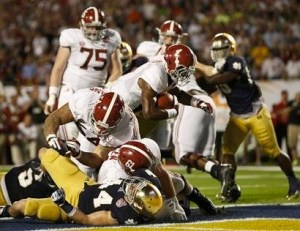
tide2013Last Monday evening, I sat down to watch a very entertaining football game. Now, I know up here is Pats’ country, so many of you probably didn’t even realize the college football championship game was going on. But I grew up in Tuscaloosa, Alabama, so I was ready for my Crimson Tide to take it to the Notre Dame Fighting Irish. (Which they did, by the way.) Because I was watching a live sporting event, I didn’t have the opportunity to fast forward through the commercials. One commercial aired several times, and I became more and more uncomfortable every time I watched it.

The commercial is for a new smartphone, the “Droid DNA.” The thirty-second spot begins with a man being strapped to a chair. A lab-coated technician secures the phone to the man’s chest, and over the thirty seconds of the commercial, the phone “rewrites” the man’s DNA. A mechanical voice announces that the man’s “neural speeds” are increasing and his brain is upgrading to a “quad-core processor.” At the end of the commercial, a voiceover says, “Introducing Droid DNA by HTC. It’s not an upgrade to your phone, it’s an upgrade to yourself.”

Now, perhaps I was uncomfortable with the idea of a phone taking the place of my brain because ever since I wrote Digital Disciple I have been fighting this tendency tooth-and-nail. Or perhaps I was uncomfortable because by the end of the commercial, the man looked like one of the Borg on Star Trek. These two surely played a part. But I think I was uncomfortable mostly because the commercial let me know something about myself that I didn’t know before. According to the commercial, I am due for an upgrade. I am deficient in some way, and only the Droid DNA smartphone will make up for that deficiency.

This is how marketing campaigns work. They tell us ways we are defective, and then they try to sell us products designed to improve those defects. Truck commercials tell men they aren’t manly unless their vehicles can haul a couple tons of dirt. Toy commercials tell kids they won’t be happy unless they receive the hot new toy for Christmas. And don’t get me started on commercials aimed at women. Judging by the ads, women in this country have hair that isn’t shiny enough; bodies that aren’t the right shape; the wrong handbags, clothes, shoes, and earrings; too many wrinkles; and not enough diamonds.

All this must be true, right? I mean, we are bombarded with our supposed deficiencies everywhere we turn: the TV, magazines, Internet ads, the sides of buses. Then we repeat them over and over again until they seem like truth. And pretty soon, it’s not just the marketers, but everyone getting in on the fun. And that’s when the boy feels deficient because he hasn’t played the video game all his friends are talking about. That’s when the girl feels defective because she doesn’t quite fit the clothes her friends have started to buy. That’s when the parents feel substandard because they can’t afford the tuition at the “best” college. At one point or another, our society as a whole started believing in our supposed deficiencies, hence why Americans aren’t very happy people.

But we have been deceived.

Today’s Gospel reading uncovers the deception and offers the supreme truth that has the potential to scrub away all the battering our self-esteem has taken over our supposed deficiencies.

At the beginning of his ministry, Jesus is baptized. After he rises from the water, he prays, Luke tells us, and the heavens open. And the “Holy Spirit descends” on Jesus in “bodily form like a dove.” The voice of God speaks from heaven: “You are my Son, the Beloved; with you I am well pleased.”

Now, you might be wondering what these words have to do with counteracting our supposed deficiencies. After all, God is talking to Jesus, not to us, right? Of course, God would be well pleased in Jesus, who has no deficiencies.

Ah, yes, we who have been programmed to think of ourselves as hopelessly deficient beings wouldn’t possibly presume to think that God might be talking to us as much as God is talking to Jesus. But we would be wrong.

Remember that the Holy Spirit descends on Jesus like a dove. This same Spirit dwells within each one of us, animating us and speaking life into our souls. Thus, we are connected to the God who spoke those words to Jesus. But we are not just connected to God. Hear what Paul says to the church on Rome: “For all who are led by the Spirit of God are children of God. For you did not receive a spirit of slavery to fall back into fear, but you have received a spirit of adoption. When we cry, ‘Abba! Father!’ it is that very Spirit bearing witness with our spirit that we are children of God, and if children, then heirs, heirs of God and joint heirs with Christ” (8:14-17).

Not only are we connected to God, we are God’s children, and not only God’s children, but heirs right alongside Jesus. So God’s words at Jesus’ baptism are not just for Jesus. They are for us, as well. You are my son. You are my daughter. You are my beloved. With you I am well pleased.

With you I am well pleased. Notice that God loves Jesus, God is pleased with Jesus, even though Jesus has done nothing yet to earn God’s love and pleasure. At this point in Luke’s Gospel, we are at the very beginning of Jesus’ ministry. All of his miracles, his sermons, his death and resurrection – they are all ahead of him. Before any of that happens, God showers upon him God’s love and pleasure.

Likewise, you and I who are joint-heirs with Christ have never done anything in our lives, nor will we do anything in our lives, to earn God’s love and pleasure. They are ours intrinsically. They are ours because we are God’s. And because we cannot earn God’s love and pleasure, we cannot do anything to lose them either. They are part of what makes us who we are – the best part of what makes us who we are.

At Jesus’ baptism, God took the opportunity once for all time to tell all of God’s children that we are loved and that we are a delight to God. We can ignore these fundamental truths. We can choose to think they don’t apply to us. But we cannot undo them, no matter what.

That God chose Jesus’ baptism in the River Jordan as the opportunity to reveal these truths to us is simply wonderful. What is the one thing in this world that is more prevalent than advertising targeted at our supposed deficiencies? That’s right. Water.

So the next time you take a shower, the next time you wash your hands, the next time you take a drink or get stuck in the rain, I invite you to feel the water touch your skin. Remember your own baptism. Remember that all of our supposed deficiencies, which teach us to think we are defective or substandard, are no match for the fundamental truth that God has built into the fabric of life. You are God’s children. You are God’s beloved. And with you, God is well pleased.


In Your Very Skin (January 11, 2013)

…Opening To…

Just like a deer that craves streams of water,
my whole being craves you, God.
My whole being thirsts for God, for the living God. (Psalm 42:1-2a)

…Listening In…

“Your mother died to save you. If there is one thing Voldemort cannot understand, it is love. He didn’t realize that love as powerful as your mother’s for you leaves its own mark. Not a scar, no visible sign… to have been loved so deeply, even though the person who loved us is gone, will give us some protection forever. It is in your very skin.” (Albus Dumbledore, Harry Potter and the Sorceror’s Stone)

…Filling Up…

We have come to the final day of our first Harry Potter week on devo180. And no week about the first book would be complete without a discussion of the sentences above. Read from the perspective of a follower of Jesus, Dumbledore’s words about love drip with the power of the resurrection. In a sense, we know that resurrection is real because the love we have for those who have died doesn’t go away. True love is never one-sided. So when our love lingers for a deceased loved one, then we can be sure the love of that person lingers as well. How could it possibly if the person is dead?

All love is held in trust by God. Whether we acknowledge it or not, all love passes through God because all love is of God. Our deceased loved ones are even closer to God’s presence than we are because of the power of the resurrection. And therefore, their love for us still matters in our lives.

Dumbledore doesn’t speak in such theological terms, but J.K. Rowling, it seems to me, illustrates this understanding of love through the image of Lily Potter’s loving, self-sacrificial protection of Harry. Her love for him lingers in his very skin. Voldemort doesn’t understand this (what C.S. Lewis might have called a part of the deeper magic from before the dawn of time). Voldemort is obsessed with cheating death, so he never seeks to understand that there is a power beyond death that one can only access once one has passed through death’s gate.

Harry’s mother’s love does not evaporate when she dies. Instead, it “leaves its own mark.” It’s an invisible mark, though Harry seems to think Dumbledore means Harry’s scar. This mark resonates for me with the scene in the Gospel when the resurrected Jesus invites Thomas to touch the marks that Jesus’ own self-sacrificial love has made. Lily’s love illustrates Christ’s. Later in the series, Harry will follow the same path. But that love lingers in our very skin. And this is how we know resurrection is real.

…Praying For…

Dear God, you are love, and I am only able to love because you desire me to have the capacity. Help me to love others with the unselfish love of your Son, Jesus Christ, in whose name I pray. Amen.

…Sending Out…

I leave this moment with you, God, glad to know that, even though I am a muggle, you still weave your magic through my life.