We limit not the truth of God to our poor reach of mind,
To notions of our day and place, crude, partial, and confined;
No, let a new and better hope within our hearts be stirred;
The Lord has yet more light and truth to break forth from his word. (George Rawson)
…Listening In…
You have turned my wailing into dancing; you have put off my sackcloth and clothed me with joy. (Psalm 30:12; context)
…Filling Up…
This seventh verse from my old guitar case has long been my favorite verse in the entire Psalter (that’s the fancy word for the book of Psalms). I have no idea how it came to my attention, but I’m glad it did because every once in a while it pops into my head and I sing it to myself for hours.
I just love how the psalmist uses the language to show the 180-degree turn that has happened because God showed up (or more likely because the psalmist realized that God was there all along). Earlier in the psalm, the writer says, “Weeping may spend the night, but joy comes in the morning.” This nightlong weeping turns into dancing when the psalmist notices what God is doing in his or her life.
Likewise, the psalmist lets God remove the sackcloth – that is, the garment of mourning – and figuratively clothe the writer with joy. Think about that. What does it mean to be “clothed with joy?” We wear clothes on the outside of our bodies. They are often the first things people notice about us. Wouldn’t it be amazing if the first thing others saw when they look at us is joy. What a first impression. This is the gift that God promises the psalmist in Psalm 30—that even though there is cause to weep, there is also cause to find great joy. And not only to find joy, but to wear it on your skin for all to see.
…Praying For…
Dear God, you are the source of my joy and the grace behind my dance. Help me to wear that joy outwardly so that others can see and feel it and find joy themselves. In Jesus Christ’s name I pray. Amen.
…Sending Out…
I leave this moment with you, God, grateful for the opportunity to reflect on your word and looking forward to discovering its impact on my life.
We limit not the truth of God to our poor reach of mind,
To notions of our day and place, crude, partial, and confined;
No, let a new and better hope within our hearts be stirred;
The Lord has yet more light and truth to break forth from his word. (George Rawson)
…Listening In…
This is my commandment, that you love one another as I have loved you. No one has greater love than this, to lay down one’s life for one’s friends. (John 15:12-13; context)
…Filling Up…
Moving down my old guitar case, we come to the sixth verse, which is wedged in diagonally right where the body of the case starts getting wider. I imagine that I taped this verse to the guitar case sometime around Easter one year during college. Jesus speaks these words to his disciples (whom immediately after this he calls “friends”) during his long speech right before he is betrayed, accused, convicted, and killed. So the words here are immediate. Jesus is telling his disciples just how much he loves them (and us) – enough to sacrifice himself in order that they (and we) might have access to that same love.
But beyond the immediate context of Jesus’ final meal with his friends, the words speed through the centuries and lodge themselves into our hearts. Notice that he commands his disciples to love one another. Jesus doesn’t command them to do very many things, but this is one thing he commands them to do on multiple occasions. Does it seem strange to you that he would command one to love another? It might, especially if you think of love primarily as an emotion. “I can’t help loving who I love and not loving who I don’t,” we might protest.
But love is not primarily an emotion. Love is a state of being. Love is the word we use for the voluntary conviction that propels us to step outside of our selfish selves and to discover the riches of building up one another, of finding mutuality, of respecting difference, of speaking out against intolerance and hate. If you’ve read the Harry Potter series, you know that Albus Dumbledore tells Harry on multiple occasions that Harry’s greatest gift is his ability to love. This gift compels Harry into many difficult circumstances, but it also strengthens him to face the challenges before him. If this love were a simple emotion, Harry would never have sustained it for so long, even to the point of his own sacrifice. J.K. Rowling knows that love is not just an emotion.
And so does Jesus. When he commands us to love, he gives us the opportunity to find the state of being that allows us to see a glimpse into God’s own being.
…Praying For…
Dear God, your Son commanded us to love as he loves. Help me to find the conviction to live a life where love is at the center of all my actions. In Jesus Christ’s name I pray. Amen.
…Sending Out…
I leave this moment with you, God, grateful for the opportunity to reflect on your word and looking forward to discovering its impact on my life.
We limit not the truth of God to our poor reach of mind,
To notions of our day and place, crude, partial, and confined;
No, let a new and better hope within our hearts be stirred;
The Lord has yet more light and truth to break forth from his word. (George Rawson)
…Listening In…
Then I said, “Ah, Lord God! Truly I do not know how to speak, for I am only a boy.” But the Lord said to me, “Do not say, ‘I am only a boy,’ for you shall go to all whom I shall send, and you shall speak whatever I command you. Do not be afraid of them, for I am with you to deliver, says the Lord.” (Jeremiah 1:6-8; context)
…Filling Up…
We continue surveying the verses on my old guitar case this week. As I said last week, I pasted all the verses on the case during college, which also happened to be the time I was beginning to discern my call to ordained ministry. I was 19 when that whole adventure began (or, at least, when I noticed I was part of that whole adventure), and so these verses from Jeremiah spoke to me.
Jeremiah makes an excuse to God when God calls him to serve: “I am a boy!!” But God doesn’t want to hear it – what’s that matter, God says. I am with you and that should be enough. This is what God usually says when people give God reasons for why they aren’t the right person for the job. And, of course, God dismisses those reasons. And God does so for one simple reason. Whatever the person’s perceived inadequacy (one of which is youth in Jeremiah’s case), God still chooses that person. In fact, God may very well choose people specifically because of an inadequacy — because in our inadequacies is imbedded the most room for us to grow.
If you feel God calling you to a particular place or situation and a reason not to do it crops up in your mind, it may turn out not to be the right call. On the other hand, that reason has a really good chance to be the very thing that God pegged within you that makes you the right person for the job. If you accept the call to serve, you will grow, you will discover new gifts, you will change for the better. And perhaps that old inadequacy will one day turn into a new strength for which to give God thanks.
…Praying For…
Dear God, you call all people to serve in unique ways. Help me to trust that you are calling me to places and situations in which I will find your presence and your grace expanding my abilities to meet the task at hand. In Jesus Christ’s name I pray. Amen.
…Sending Out…
I leave this moment with you, God, grateful for the opportunity to reflect on your word and looking forward to discovering its impact on my life.
Sermon for Sunday, May 19, 2013 || Pentecost, Year C || John 14:8-17, 25-27
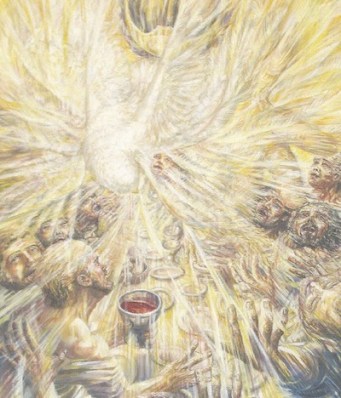
In today’s Gospel reading, Jesus makes one of his biggest promises ever. He is in the middle of his discussion with the disciples, which takes place on the night of his arrest. You can tell from their questions that they are worried, anxious, and fearful. So Jesus promises them this: “I will ask the Father, and he will give you another Advocate, to be with you for ever. This is the Spirit of truth…[the Spirit] abides with you, and…will be with you.”
Jesus made this promise, and if there’s one thing I can believe in, one thing I can rest my weight on, it’s that Jesus never breaks a promise. The Spirit of truth, the Holy Spirit, has been and will be active in the lives of God’s people forever. But the trouble for us followers of Jesus comes, rather paradoxically, in the very constancy of the Holy Spirit’s presence. We humans are so much better at noticing the things that change. The constant things tend to fade into the background of our lives.
Take breathing, for example. Breathing just happens. I’m breathing right now, and I’m not giving my breath a second thought. I can be unconscious all night, and yet my breath keeps going, independent of my control. For the better part of each day, I am completely unaware of my breathing, and yet my respiratory system continues to function with constant efficiency.
But in one of God’s marvels of human engineering, if I decide to, I can focus on my breath. I can choose to take in a deep lungful of air, or I can choose to hold my breath underwater, or I can choose to let my breath out slowly to calm myself down. Breathing is an unnoticed constant in our lives until we decide to focus on the air entering and exiting our lungs. Then the act of breathing becomes something that we consciously participate in.
Do you know what is the same word as “breath” in the ancient biblical languages? You guessed it. Spirit. Just like our breath, the Holy Spirit is a constant presence in our lives, active within and around us. Because of this constancy, we have a tendency to overlook the Spirit’s presence and to allow the Spirit to fade into the background. But also just like our breath, we have the opportunity to focus on the Holy Spirit’s presence, to breath in a deep lungful of the Spirit, so to speak. When we do this, we actively participate in the transformation that the Spirit is subtly working in our lives.
I’d like to spend the rest of this sermon speaking about several ways the Spirit moves. This won’t be an exhaustive list by any means, but I encourage you to listen for a way in which the Spirit has moved in your life, or a way you pray the Spirit will move.
If you’ve ever had the impulse to create, then you’ve felt the Holy Spirit move in your life. If you’ve ever penned a poem or sang a song or played an instrument or stepped a dance or planted a garden or written a love letter or experimented with ingredients or built an imaginary world or raised a child or made a dream a reality, then you’ve participated in the Holy Spirit’s movement.
The Spirit connects with us via the creative spark, which God implanted in each of us. Being made in the image of God means that God gave us the gift of imagining. The Creator made us to be creative. And just as the Holy Spirit was with God, brooding over the depths at the moment when God spoke creation into being, the Holy Spirit is also with us when we access our own creativity. In fact, the Spirit catalyzes the creative process in us. God has never stopped creating; therefore, one of the ways the Spirit keeps us in relationship with God is keeping us creating too. In my own life, whenever I sit down to write a song, I know the Spirit has prompted me to do so and will guide me as I create new music. So that’s number one: the creative impulse.
If you’ve ever sensed which direction to go, then you’ve felt the Holy Spirit move in your life. If you’ve ever been lost – not on the map, but in your heart – and then felt a subtle beckoning down a new path, and at the moment you took the first step in that new direction you felt your heart shine with the rightness of it all, then you’ve participated in the Holy Spirit’s movement.
The ancient biblical languages use the same word for breath and spirit and for another word: wind. The Holy Spirit is the unseen wind, which subtly pushes us in one direction or another. The wind is both constant and unpredictable, always blowing, but perhaps blowing in a direction we might not expect. When we are lost, the Holy Spirit is present, and we have the opportunity to trim our sails and catch the wind. In my own life, I’ve experienced the Spirit’s presence in this way at the rare times when I have actually been able to give up control. That’s number two: sense of direction to go along with the creative impulse.
If you’ve ever had a sudden sense of peace wash over you, then you’ve felt the Holy Spirit move in your life. If you’ve ever been rushing around, moving to and fro, trying to keep up, trying just to keep your feet in a maelstrom of activity, but then something prompted you just to stop, take a deep breath, then you’ve participated in the Holy Spirit’s movement.
Each time Jesus gives his friends the gift of the Spirit, he also gives them his own peace. Peace is not just the absence of conflict; rather, peace is the soil in which new wholeness grows out of old fragmentation. The Holy Spirit nurtures this growth in us, always pushing us away from brokenness and towards wholeness, towards peace. In my own life, the Spirit has encountered me in this way when I have stopped doing, stopped acting, and have just existed for a spell, just abided in the Spirit’s constant presence. That’s three: sense of peace. Sense of direction. Creative impulse.
Finally, if you’ve ever felt deeply connected to another person, then you’ve felt the Holy Spirit move in your life. If you’ve ever held another’s hand or embraced or laughed together and known in a place deeper than normal knowing that your two souls are connected, woven together, then you’ve participated in the Holy Spirit’s movement.
The Holy Trinity is the perfect relationship of Father, Son, and Holy Spirit — so perfect, in fact, that there is only one God, though we name God as three persons. There cannot be a Father without a Son, nor a Son without a Father. Nor can there be the perfect relationship without love. This love connecting Father and Son in perfect relationship is the Holy Spirit. Whenever we feel a deep connection to another person, we are participating in our own small way in the divine relationship of the Trinity. The Holy Spirit makes our loving connections possible. In my own life, I’ve felt this deep connection since the day I met Leah, and I expect I’ll feel it again when we have our own children. That’s four: deep connection.
The creative impulse. Sense of direction. Sense of peace. Deep connection. These are only four of the vast expanse of ways the Holy Spirit is moving in our lives. Like breathing, the Spirit is active whether or not we recognize the Spirit’s movement. But God engineered us to be capable of focusing on our breath and on the Holy Spirit. So I invite you this week to celebrate the Spirit’s movement in your life. Engage in an act of creation. Catch the wind blowing you in a new direction. Stop for a moment and embrace a sense of peace. Rejoice in the deep connections in your life. And know in the place deeper than normal knowing that God the Holy Spirit will abide with you forever.
Words written fifty years ago, a hundred years ago, a thousand years ago, can have as much…power today as ever they had it then to come alive for us and in us and to make us more alive within ourselves. (Frederick Buechner)
…Listening In…
But those who wait for the Lord shall renew their strength, they shall mount up with wings like eagles, they shall run and not be weary, they shall walk and not faint. (Isaiah 40:31; context)
…Filling Up…
Verse four on the guitar case comes from the end of the 40th chapter of the book of the prophet Isaiah and it is in the running for most beautiful verse of scripture in the entire Bible. I can’t remember what made me put on the guitar case, but it’s influence since I have has been profound. Ever since I began walking with families through their grief at the death of a loved one, I have suggested the reading that includes this verse for one of the readings at the funeral.
This verse is full of hope, but at the same time, it acknowledges just how severely life can run you down. It does not gloss over the reality that the daily grind coupled with the occasional catastrophe can erode away a person to nothingness. It speaks about renewing strength, implying that strength has been lost; about flying like an eagle, implying that there has been a low point; about becoming weary; about fainting.
But rather than speaking directly about losing strength and fainting, Isaiah speaks as if those things have already or will soon pass. He doesn’t say that those who wait for the Lord might renew their strength. He says that they will renew their strength. He speaks as if they are foregone conclusions. And you know what, when we are speaking of God’s promises, they are.
…Praying For…
Dear God, you will always bear me up when I fall. Help me to believe the promises you make to your people through the words of your prophets, so that I may continue to fly upon the wings of your faith. In Jesus Christ’s name I pray. Amen.
…Sending Out…
I leave this moment with you, God, with your words on my lips and your joy in my heart, ready to share both with all I meet.
Words written fifty years ago, a hundred years ago, a thousand years ago, can have as much…power today as ever they had it then to come alive for us and in us and to make us more alive within ourselves. (Frederick Buechner)
…Listening In…
I will praise the Name of God in song; I will proclaim his greatness with thanksgiving. (Psalm 69:32; context)
…Filling Up…
The third verse down the neck of my guitar case comes from a special type of psalm called a “psalm of lament.” In this category of psalm, the writer bewails a tragedy (or two or three or four) that has befallen. The writer goes on to wonder if God is anywhere nearby or if God is going to help out because it sure seems that God has cut and run.
Now, you think: “Gee, that verse above does sound very much like a lamentation. Are you sure you got the citation right, Adam?” Good observation. Yes, the citation is correct. And yes, this verse doesn’t sound much like the thirty plus verses that come before it. Indeed, the first four verses of the psalm read, “Save me, O God, for the waters have risen up to my neck. I am sinking in deep mire, and there is no firm ground for my feet. I have come into deep waters, and the torrent washes over me. I have grown weary with my crying; my throat is inflamed; my eyes have failed from looking for my God.”
This is one grief-stricken psalmist. How could the writer get from looking for God to praising God in song? Good question. Right here is where the future tense comes in. Notice that the psalmist says, “I will praise… I will proclaim…” The psalmist is mired in grief, blinded by sorrow. This writer feels abandoned and on the verge of despair. At the moment of penning this psalm, the writer cannot praise God or proclaim God’s greatness.
But even in this deepest lamentation, there is a glimmer of hope, and that glimmer is captured in the future tense. Someday – maybe not tomorrow or next week or next year – but someday, the psalmist will once again praise the name of God again. Psalms of lamentation give us an example to follow when we are in the midst of grief. They give us permission to feel the feelings of loss and sorrow and abandonment. But they also give us the hope that praising and singing and thanksgiving will come again in time.
…Praying For…
Dear God, you never abandon me, even when I cannot feel your presence. Help me when I am on the verge of despair to hold on to the sliver of hope that is a future full of your presence. In Jesus Christ’s name I pray. Amen.
…Sending Out…
I leave this moment with you, God, with your words on my lips and your joy in my heart, ready to share both with all I meet.
Words written fifty years ago, a hundred years ago, a thousand years ago, can have as much…power today as ever they had it then to come alive for us and in us and to make us more alive within ourselves. (Frederick Buechner)
…Listening In…
O Lord, you have dealt graciously with your servant, according to your word. Teach me discernment and knowledge, for I have believed in your commandments. (Psalm 119:65-66; context)
…Filling Up…
The second verse from the top of the guitar case comes from the longest psalm in the book. In fact, the verses quoted above are at the beginning of the second third of the psalm. There are over 100 verses after that! Anyway, I remember pasting these two verses to my guitar after I started the formal process of discernment for ordained ministry. This is probably why I was struck by the phrase “teach me discernment.”
Basically, the psalmist wants to learn how to learn. “Teach me discernment” could also read, “show me how to open my eyes so I can begin to see properly.” Or “show me how to work these legs of mine so I can start following your path.” When the psalmist asks God to teach discernment, the psalmist shows that he has discovered that he is at the very beginning of his journey, no matter that a third of the psalm is already through.
Even though I am now a priest (that is, I navigated the six year process from initial inquiry to ordination), I still need to ask God to teach me how to discern. Discernment happens when you cultivate an atmosphere of prayerful reflection. Within this atmosphere, the discerner asks God to be present in the act of noticing all the choices in front of him or her. In the end, discernment is all about seeing the whole field when you make a decision (sorry for that football metaphor; it sort of snuck in). Every quarterback (even Tom Brady and Peyton Manning) has a coach to help him see the field. And we do too. So my prayer is that we each ask God to teach us discernment.
…Praying For…
Dear God, you continue to teach me things every day of my life. Help me to be receptive to those lessons so that I can invite you into every decision I make and find a fuller life in you. In Jesus Christ’s name I pray. Amen.
…Sending Out…
I leave this moment with you, God, with your words on my lips and your joy in my heart, ready to share both with all I meet.
Words written fifty years ago, a hundred years ago, a thousand years ago, can have as much…power today as ever they had it then to come alive for us and in us and to make us more alive within ourselves. (Frederick Buechner)
…Listening In…
For you were called to freedom, brethren; only do not use your freedom as an opportunity for the flesh, but through love be servants of one another. (Galatians 5:13; context)
…Filling Up…
The old guitar case has fourteen verses of scripture taped to it. The one at the top of the case is Galatians 5:13. The words that grabbed me at the time I pasted it to the case were, “You were called to freedom.” And these words still grab me today.
What does this mean, to be “called to freedom?” Well, if we are called to freedom, it means there are points in our lives when we are not free. Things that are not God, but which we mistake for God, can enthrall and enslave us. We sacrifice our freedom when we mistake a created thing for the Creator, when we devote ourselves to something unworthy of devotion. This might be wealth or the need for dominance or the seductive power of a video game or alcohol or drugs.
When we choose these things over God, we put ourselves into voluntary confinement. But God calls to us in this prison. God speaks the words of freedom to us, and reminds us that when we serve God, we are truly free. That is why this verse seems paradoxical. We are called to freedom and called to serve others. True freedom, therefore, happens when we choose to serve each other out of love. When we make this choice, we access a portion of the love of God that is given freely to all, and thus we find freedom.
…Praying For…
Dear God, you grant me free will so that I can choose freely to follow you. Help me make that choice each day of my life, that I may discover how you are calling me to serve others. In Jesus Christ’s name I pray.
…Sending Out…
I leave this moment with you, God, with your words on my lips and your joy in my heart, ready to share both with all I meet.
Words written fifty years ago, a hundred years ago, a thousand years ago, can have as much…power today as ever they had it then to come alive for us and in us and to make us more alive within ourselves. (Frederick Buechner)
…Listening In…
By the word of the Lord were the heavens made, by the breath of his mouth all the heavenly hosts. (Psalm 33:6; context)
…Filling Up…
I got my first guitar around Christmas of my senior year of high school. For the life of me, I can’t remember if it was a Christmas present or if I bought it with Christmas money. Either way, it was pretty cheap, and because it was pretty cheap, I felt comfortable storing it in a “gig bag.” Gig bags provide enough cushion against the odd bump or jostle, but they won’t protect an instrument from being squashed or simply dropped.
So when I got my second guitar a little over a year later, I splurged on a hard case. I knew I was in this guitar playing thing for the long haul, so a hard case seemed like a good investment. Also, the second guitar was much nicer than the first. (That, of course, didn’t make it great because the first one was really cheap.)
Just like when you start seeing the make of your new car all over the road, I began seeing hard guitar cases all over my college campus. Most of them were plastered with decals from bands and bumper stickers with clever puns on them. Each case said something about the owner: the constellations of stickers were collages of personal expression. I began thinking about the decals I wanted to stick to my new case, but I just couldn’t come up with any.
Then I got an idea. I bought some black construction paper, duct tape, and a silver Sharpie. And over the course of the next few years, I taped to my guitar case all of the verses from the Bible that grabbed hold of me and wouldn’t let me go. I rarely use that guitar anymore, having been given a beautiful Taylor for my ordination to the priesthood (what a gift!!). But the old case still sits in my office, and everyone once in a while I go back and read those verses that meant something to me all those years ago.
I’d like to share them with you over the next couple of weeks. There are fourteen verses, so we’ll be done with the case at the end of this month. I invite you over the course of the month to make a collage of verses that grab you, whether from those taped to my guitar or those you read or hear during your week.
…Praying For…
Dear God, your word continues to speak life into my being. Help me to listen to your voice speaking to me through the words of scripture. In Jesus Christ’s name I pray. Amen.
…Sending Out…
I leave this moment with you, God, with your words on my lips and your joy in my heart, ready to share both with all I meet.
Once I heard and answered all the questions
of the crickets,
And joined the crying of each falling dying
flake of snow,
Once I spoke the language of the flowers…
How did it go?
How did it go? (Shel Silverstein, “Forgotten Language”)
…Listening In…
Some people brought children to Jesus so that he would place his hands on them and pray. But the disciples scolded them. “Allow the children to come to me,” Jesus said. “Don’t forbid them, because the kingdom of heaven belongs to people like these children.” Then he blessed the children and went away from there. (Matthew 19:13-15; context)
…Filling Up…
The natural physical manifestation of imagination and wonder is our final thing to access from our early childhoods. This is called Play. Play happens when we engage both our imaginations and our bodies. We dance to unheard music, we build castles with pillows and sheets, we sculpt mountain ranges with our mashed potatoes, we hum the language of mosquitoes.
For our early years, play is the most common manner in which we encounter and learn about the world. There is very little separation between play and the rest of life. There’s no such thing as “playtime” because all time is playtime. Play leads to better manual dexterity, better spatial relations, and more active imagination. But at some point during childhood, play becomes segregated from the more serious side of life. Parents tell children to “stop playing with your food.” The message is now: “Dinner is serious business.”
But this segregation between “play” and “the rest of life” can be damaging to our walks with God. The more pure the play of small children, the more they are able to access the unfettered creativity that God used when creating the Universe. In a sense, God was playing during creation: what other explanation could there possibly be for the duck-billed platypus!
So go ahead and play with your food. Make a mashed potato mountain range, and maybe you will find yourself in a deeper connection with the One who made the real mountains.
…Praying For…
Dear God, you filled your Creation with wonders for us to see and learn about. Help me to find the curiosity and the inhibition to be truly playful again, that I might let go of the bounds I have put around you. In Jesus Christ’s name I pray. Amen.
…Sending Out…
I leave this moment with you, God, joyful that I have been in your presence for my whole existence, whether I remember or not.

 …Opening To…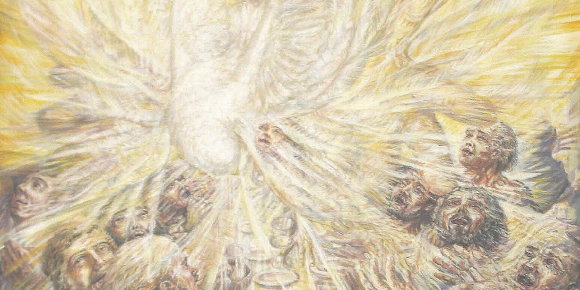
 Jesus made this promise, and if there’s one thing I can believe in, one thing I can rest my weight on, it’s that Jesus never breaks a promise. The Spirit of truth, the Holy Spirit, has been and will be active in the lives of God’s people forever. But the trouble for us followers of Jesus comes, rather paradoxically, in the very constancy of the Holy Spirit’s presence. We humans are so much better at noticing the things that change. The constant things tend to fade into the background of our lives.
 Where the Wind...