
Sermon for Sunday, February 22, 2026 || Lent 1A || Romans 5:12-19
Today, on this first Sunday in Lent, I’m going to talk with you about sin. “Sin” is very much a “church” word, a word that we use liturgically in our Confession of Sin and a word that crops up in the Bible, nowhere more frequently than in Paul’s Letter to the Romans, which we read this morning. “Sin” is such a “church” word that we have trouble decoupling it from our liturgical expression in order to see how sin operates in big and little ways in our everyday life. So today we are going to reexamine Sin so we can get a better look at its patterns in the world.
But first, just a little story from college that our readings reminded me of. Every year, the University Choir at Sewanee sang a couple of selections from Handel’s Messiah during Easter season. One was the chorus known as “Since by man came death,” which is from First Corinthians, but the lyrics are very similar to our reading from Romans today. The words of the chorus are: “Since by man came death, by man came also the resurrection of the dead. For as in Adam all die, even so in Christ shall all be made alive.” Every time we rehearsed this piece, the choir director, the formidable Dr. Delcamp, looked right at me when we sang, “For as in Adam all die.” Like it was my fault. He’d be conducting like normal and then, all of a sudden, just glare at me. If I hadn’t known he was joking, I would have found it intimidating!
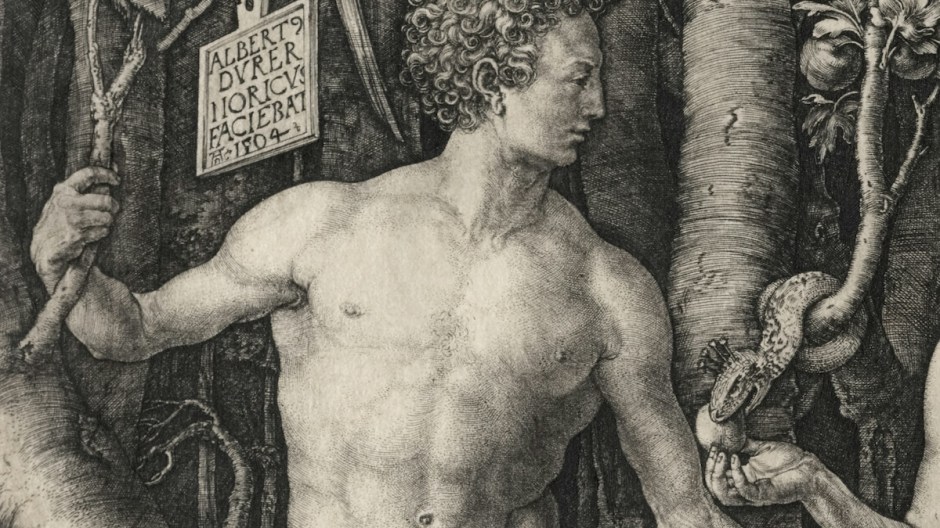
So, whenever I read the Genesis story of Adam and Eve or Paul’s subsequent use of the story in his letters, I always feel a little personally put upon due to my namesake. For all the other Adams out there, let me offer our profound apologies for the actions of the first Adam, who got us all into this mess in the first place.
Or, at least, that’s how St. Paul tells the story. Paul links the story of Adam to the story of Jesus, saying: “For just as by the one man’s disobedience [Adam’s disobedience] the many were made sinners, so by the one man’s obedience [Christ’s obedience] the many will be made righteous.”
Now, this sermon is not the place to get into the historicity of the story of Adam and Eve. Their story is not concerned with historical fact; it is concerned with the truth of the human condition. And this truth is that, through our actions and inactions, we separate and isolate ourselves one from another and from God, thus distorting personal and communal relationships. These distortions take the forms of fear, envy, abuse, and the desire for dominance. In personal terms, sinful distortions lead to unhealthy, imbalanced relationships. In communal terms, sinful distortions lead to big systemic injustices like racism, sexism, classism, and ableism.
Paul links the concept of sin with the reality of death: “As sin came into the world through one man, and death came through sin, and so death spread to all because all have sinned.” You don’t necessarily have to agree with this formulation in order to understand how Paul then mirrors it. Sin and death through Adam. Grace and life through Jesus Christ. This brings us the shorthand that I use in sermons all the time: the dichotomy between the death-dealing ways of the world and the life-giving ways of God. Sinful distortions lead to death. Graceful reconciliations lead to life.
Placing these two ideas on a spectrum – with death-dealing on one side and life-giving on the other side – can help us understand how we are trending in our own lives. In any given decision, action, or inaction, which end of the spectrum are we moving toward? If death-dealing, then you will probably have some sort of negative physical reaction, a spiritual lethargy or feeling of unraveling. Something will just feel off somehow, because in that moment of decision, you will not have acted from the authentic self that God is loving into being. Conversely, if you make a life-giving decision, you will feel enlivened, a spiritual energy that resonates with the authentic self. Even if that decision leads to hardship or a time of trial, you will know that it was the right one to make.
As I wrote this sermon, I realized that the spiritual lethargy I have succumbed to many times over the last few months is due to the helplessness I feel in the face of the targeted injustices happening right now in the United States. There are too many to mention here, but the actions of ICE in Minnesota top the list. This spiritual lethargy tells me that I am trending toward the death-dealing end of the spectrum. So the question I bring to God in prayer is this: how do I turn around and move the other direction, toward the grace-filled life-giving end?
And the answers I receive in prayer are multitudinous – so many that I wonder how I ever could have thought there were no responses left! Depending on one’s capacity on any given day, moving away from sin and toward life might look like any number of things:
- Going to a protest to stand in solidarity with those unjustly detained
- Amplifying important voices of dissent so they don’t get drowned out
- Contacting your elected officials to demand justice and accountability
- Looking in on your neighbors and deepening community bonds
- Sitting in the silence of meditative prayer
- Calling a friend to reconnect
- Creating art
- Taking a full breath of air…and then another and another.
I’m sure you can add to this list, and I would be very glad to hear the ways God is inviting you into life right now. As we all choose every single day, in every action, how to respond to the death-dealing ways of the world, I am reminded of the words of the Confession Sin. We confess what we have done and what we have left undone. In my spiritual lethargy, I recognize so much that I am leaving undone right now. To counteract this, I must begin to claim the word “sin” as something more than a “church” word. I must claim the reality of sin in the wider world because “sin” as an overarching concept is bigger than the concept of legality.
In the history of the world, the worst of atrocities were technically legal within whatever framework of law was operative at the time. But those atrocities were most assuredly sinful.1 The same is true today. When we name unjust and oppressive actions as sinful, the fact that some claim them to be legal does not matter. Our moral and ethical responsibilities are clear: The God of justice calls us to stand against white supremacist justifications for immigration purges; to stand against the building of mass detention centers that have never before been needed to do the work of deportation; to stand against voter suppression tactics targeting poor people and women.
But if we only stand against things, then we will fall. The God of justice also calls us to stand for the love of our neighbor, to stand for the building of thick community, to stand for welcoming the stranger into our midst, to stand for truth amidst a flurry of lies. This is how we embrace life in a death-dealing world.
As we enter fully into the season of Lent, we recommit ourselves to examining how we participate in the sinful systems of the world. This participation happens sometimes due to direct action, but more often due to our inaction. This Lent I urge you to join me, with God’s help, in leaving fewer things left undone.
- St. Paul distinguishes between law and sin in our reading today: “…sin was indeed in the world before the law, but sin is not reckoned when there is no law.” In other words, in the biblical story there was no law until Moses. Sin abounded nonetheless and death followed. The reminder that sin and legality operate on two different axes is important for us as we confront those who would use the law to commit morally repugnant acts. ↩︎
 Where the Wind...