
Sermon for Sunday, October 5, 2025 || Proper 22C || 2 Timothy 1:1-14
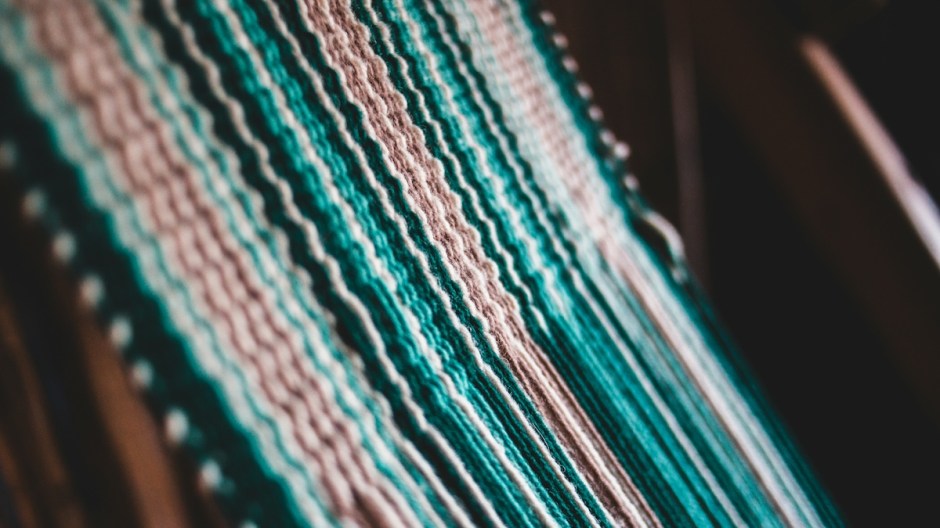
This sermon is about community, about resisting the pull of isolation, especially in an age when we are all too often isolated from one another due to many and varied forces. The community we share in the church, when practiced at its beloved best, is the weave of the fabric of faith, into which God stitches our individual threads. Today I’d like to celebrate this weaving of beloved community and talk about how such weaving can, with God’s help, heal the world.

Click here for Apple Podcasts or search
“WheretheWind.com Sermon” on your podcast app of choice.
But first a little of my own story. As some of you know, when I was eleven years old, my family was torn from the fabric of a church community when a rift formed between members of the church and my father, who was their priest. I won’t go into the details I now know, but from my young perspective, all I saw was people I thought I could trust turning on my family until we were hunkered down in the rectory like it was a bomb shelter. Desperate, my family moved all way from Rhode Island to Alabama in order to restart our lives in a new church community.
The problem was, after being burned at our last church, I could not bring myself to trust the folks at the new church. I looked at everyone with suspicion, assuming that at some point in the future they would turn on us like before. Sure, they were nice and kind and seemed to love my family, but the other shoe would drop. I was certain of it. Turns out I was wrong. My father was their pastor for nine wonderful years, during which they loved my family through our brokenness and out the other side.
And yet, I never let anyone get close. I never let myself be vulnerable. I went to church, I helped out in the nursery, I acolyted. But in the back of my mind, there were always these malignant thoughts. They’re not who they seem to be. They don’t really love you. Keep your armor on. Keep your distance. And I did. I isolated myself. I walled myself off from a host of people who only wanted to love me back to wholeness. The betrayal of one community kept me from embracing the healing of another.
But there’s a wonderful thing about an authentic beloved community. No matter the personal walls, the traumatic history, the reasons to stay at arm’s length, love seeps in. Love seeps in through the cracks, finding every break, every fissure, every crevice. Indeed, the love binds with the cracks, joining them back together like the golden mending of Japanese kintsugi. The philosophy behind kintsugi teaches that the mended cracks are part of the history of the bowl or pot and are not meant to be hidden. Rather than throwing away the broken vessel, the mender lovingly pieces it back together.
When we were forced from the church in Rhode Island, I felt disposable, I felt cast aside, thrown away. But the beloved community in Alabama took my pieces and mended them with love like gold, and they did all this even when I was keeping my distance. Looking back, I wonder how much more I could have participated in my own healing if I had allowed myself to embrace those loving people like they embraced me.
None of us lives a life of faith in isolation, even when we try to. St. Paul makes this point to his protege Timothy in today’s second reading: “I am reminded of your sincere faith,” Paul writes, “a faith that lived first in your grandmother Lois and your mother Eunice and now, I am sure, lives in you.” I have been fascinated by this verse for decades. I have always wanted to know more about Lois and Eunice, but this is their only mention in the entire canon of scripture. So that leaves us with imagination. I ask myself, how did Lois and her daughter come to faith in Christ?
Perhaps they were among the women who provided for Jesus’ band of travelers. Perhaps Lois knew what Jesus liked to eat for breakfast and Eunice knew which of the disciples was grumpiest in the morning. Perhaps they heard Jesus teach and saw him listen to women’s needs and welcome children and come near those who were sick. Perhaps they were there in Jerusalem on that fateful day, watching from a distance as their friend and savior took his last breath. They believed Mary Magdalene’s breathless announcement of resurrection. They were there when the wind of the Spirit brought new life to the community. They shared things in common, served those who were poor, witnessed miracles, maybe performed miracles themselves through the power of Christ’s name. The sincere faith that lived first in your grandmother Lois and your mother Eunice and now, I am sure, lives in you.
The faithful examples of his mother and grandmother blessed Timothy. They are part of the thick weave of the community that reaches all the way down to today. They are the best of the church, faithful examples who spurred faith in the next generation…and the next…and the next…until we came along. By the grace of God, examples like Lois and Eunice remain potent and powerful. They are able to show the church at its loving, weaving best when so often throughout history the church has been its own worst version. Today, I invite you to join me in celebrating Lois and Eunice, who instilled sincere faith in Timothy.
The celebration looks like this: Delve into your own past and remember as many people as you can who passed their faith on to you. Remember them for their love and their joy and their wisdom and their fortitude in the midst of hardship. Remember them as part of God’s weaving presence in your lives, and give thanks to God for them. Today, I remember those wonderful loving people at the church in Alabama: Nina, Bill, Jerry, Corrinne, Kim, Leigh, and so many others who, despite my best efforts to the contrary, stitched my heart into their beloved community. The faith that lives in me shines like gold because of the strong weave of the fabric of their faith.
As we celebrate these faithful connections, we participate in God’s weaving movement. We help weave ourselves more deeply into a community of love and service, which is the best of the Church. This community spans differences of age, race, gender, orientation, ableness, socioeconomic status, and political affiliation. We come together under the fundamental identity of beloved children of God, and we love one another no matter what. This living example of the weaving power of God can heal the world. So I say, “Thanks be to God.” Thanks be to God for all those who have come before us, and who are even now in our midst, whose faith forms the fabric of our beloved community.
Photo by Erik Mclean on Unsplash.
 Where the Wind...
Thank you.