
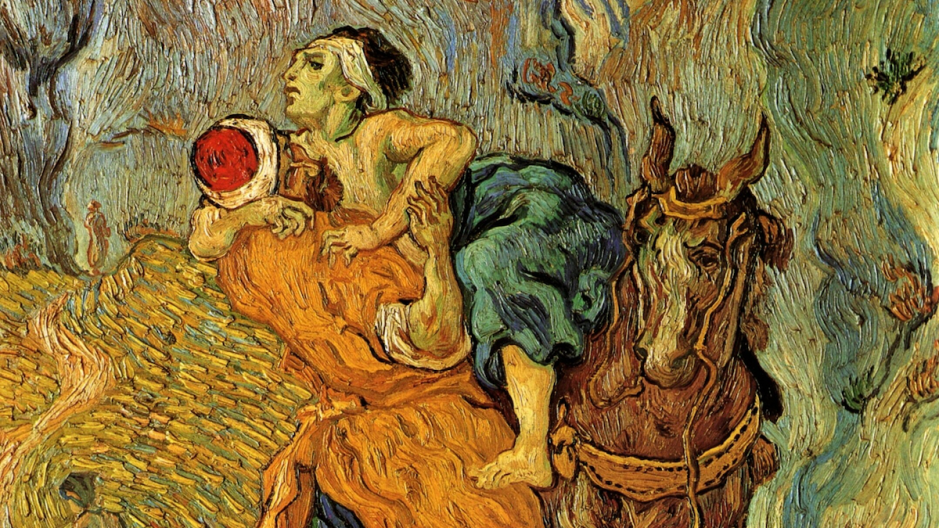
Sermon for Sunday, July 13, 2025 || Proper 10C || Luke 10:25-37
As I prepare to go on vacation after today’s services, I am so glad that the piece of scripture I get to talk about this week is the parable of the Good Samaritan. Easily in the Top Five most memorable parts of the Gospel, the story of the Good Samaritan stands as Jesus’ most enduring teaching about what it means to be in relationship with other people. So let’s spend the sermon time this morning unpacking this parable and see what Jesus has to teach us about the danger of “othering” and the power of compassion.

“WheretheWind.com Sermon” on your podcast app of choice.
As I mentioned two weeks ago, Jesus tells the parable in response to a lawyer who is litigating what constitutes a neighbor. Jesus has no energy for hair-splitting, so instead of engaging the lawyer’s question, Jesus shares this story. The parable takes the form of a standard joke: “a priest, a Levite, and a Samaritan are walking down the road…” There’s a good chance that in Jesus’ day this actually would have been a common opening of a joke, and the Samaritan would bear the brunt of the punchline. As we know from other places in the Gospel, Jews and Samaritans did not share things in common even though they lived in neighboring lands. Indeed, to get from Galilee to Jerusalem, Jesus had to walk through Samaria. The two peoples were descended from the same lineage, but Jews considered Samaritans unclean half-breeds because their ancestors had intermarried with the peoples who had conquered Israel. So Samaritans would never be the heroes of Jewish stories.
Until Jesus told this parable.
The parable really is a joke – a story that builds to a surprising conclusion that subverts expectations. No one would have expected Jesus to tell a story in which a Samaritan was the exemplar. But that’s one of the things that makes Jesus so compelling. He often did the unexpected because the expectations of behavior in his society were too cramped to allow for the grace of God to flow. With his unexpected behavior, Jesus opened the floodgates to that never-ceasing supply of grace.
Okay. Back to the parable. Jesus sets the scene: the way between Jerusalem and Jericho, which was known to be a notoriously dangerous stretch of road. Bandits fall upon the traveler, steal his belongings, and leave him dead by the roadside. The priest and the Levite come by, but (depending on how you interpret the parable) they are either too busy, too pious, or too scared to help the man. Jesus is a master storyteller. In a few simple words, he conveys so much. Not only do the priest and Levite not help the man; they cross over to the other side of the road in order to avoid him.
Jesus contrasts their actions with those of the Samaritan. Remember, societal norms dictated that the Samaritan should have nothing to do with the wounded Jewish man. But the instincts of compassion override the societal norms. The bandits might still be about. The man might be bait for their trap. So the Samaritan risks his own safety to tend to the man. Martin Luther King Jr. calls this “dangerous unselfishness.”1 Jesus makes a point to say that the Samaritan goes to the man because he is moved with compassion. “Compassion” means “to suffer with”; the Samaritan allows the man’s suffering to become his own suffering. He treats the man’s wounds and pays for his recovery. Surely by now, Jesus’ audience is wondering when he is going to make fun of the Samaritan. But that ends up being Jesus’ punchline. The Samaritan is not the butt of the joke; he’s the hero of the story.
The Samaritan is the hero because he bridges two different chasms: the personal gap between him and the wounded man AND the societal gap between two peoples who do not share things in common. His compassion, his willingness to risk himself to help another, bridges the personal gap. To bridge the societal gap, the Samaritan does not allow himself to fall for the Big Normative Lie that “others” are less important than “my people.” He extends the personal demands of compassion beyond the standard boundaries.
This extension of compassion erases the line between “my people” and “others” and reveals the truth that there is no such thing as the “other.” We are all made of the same primordial stardust. We are all made in the image and likeness of God. Whatever lines of race, class, religion, nationality, gender, sexuality, age, ability, and immigration status we draw to turn people into “others” – whatever these lines, they fall away when we embrace the fundamental identity as beloved subjects of God’s creation. There is no such thing as the “other.” Everyone we think of as “other” is a thread woven along with ours into God’s great tapestry.
With God’s help, we are able to break free of the societal program that separates “my people” from “others.” Once we find this freedom, we can never go back to the Big Normative Lie that allows us to sit around while far away people are dying from bombings or famine, while people nearby with a different skin color or accent are rounded up and sent to camps, while those working multiple minimum wage jobs are accused of being lazy because they are stuck in poverty. These people are not others. They are us. We are them. We are one. Again, Dr. King: “We are caught in an inescapable network of mutuality, tied in a single garment of destiny. Whatever affects one directly, affects all indirectly.”2
Dr. King wrote these words while in jail in Birmingham, put there by a corrupt government that would not enforce the laws which ended segregation. His own country had “othered” him, had “othered” his people for hundreds of years. And yet, King would not let himself turn around and do the same. He truly believed in that single garment of destiny. Echoing Paul’s First Letter to the Corinthians, he called for “the more excellent way of love and nonviolent protest.”3 This way of love is the stitching together of our singular unrepeatable threads into God’s great tapestry.
I invite you, this week, to pray about how God might be calling you to embrace dangerous unselfishness. Listen for God’s movement, pushing you toward acts of compassion beyond your normal circle of relationships. Stand up to the forces that seek to divide us by turning beloved children of God into “others” that can be kidnapped, imprisoned, deported, and discarded. Do not let the Big Normative Lie that “others” are less important than “my people” stand unchallenged by the truth of Jesus’ witness in the parable of the Good Samaritan. For the truth of the parable rings clearer than any lie that society tells no matter how often the lie is repeated. When we come near one another, when we risk the danger of unselfishness, when we show and are shown compassion, we discover the wonderful and joyous truth that we are one.
- “I’ve Been to the Mountaintop” (Final Sermon, April 3, 1968) ↩︎
- Letter from a Birmingham Jail (April 16, 1963) ↩︎
- ibid ↩︎
Banner: detail from “The Good Samaritan, after Delacroix” by Vincent van Gogh (1890)
 Where the Wind...