
Sermon for Sunday, January 5, 2025 || Christmas 2 || Matthew 2:13-15, 19-23
This is a sermon about biblical role models. After the service, I would love to hear what character in the Bible inspires you like Joseph inspires me. So be thinking about for the next ten minutes while I talk.

“WheretheWind.com Sermon” on your podcast app of choice.
My children were four years old when I went to Israel in 2019. The trip was the longest period of time I had been away from them since their birth. For two weeks, I did not see my family and spoke with them only sporadically. It was really weird being off by myself like that because fatherhood turns on all at once. One day, you’re not a dad; then, a little past 11am on a Tuesday in July, you are – forever. A switch flips in your life whether you’re prepared or not, and the most important role you will ever inhabit begins.
But there’s a big difference between being a father and feeling like a competent one. There were so many moments in my kids’ first few years (and some moments in recent times too) when I felt like a parental failure. I won’t list them now, but I’d be willing to bet, if you’re a parent, you can remember similar times in your kids’ early years.
So it was strange being on this two week vacation from parenting when I certainly didn’t feel like I had earned it. The secret to parenthood that no one tells you is that being a competent parent is like being a good Major League hitter. Even the best hitters only succeed three out of ten times. I didn’t know this secret back in 2019. My kids were too young to confirm whether I had done an okay job or not. So I went to Israel with this worry hidden inside me in that place you know is there but don’t want to look. The worry was that I still had no idea what I was doing as a father even though the five year mark was fast approaching.
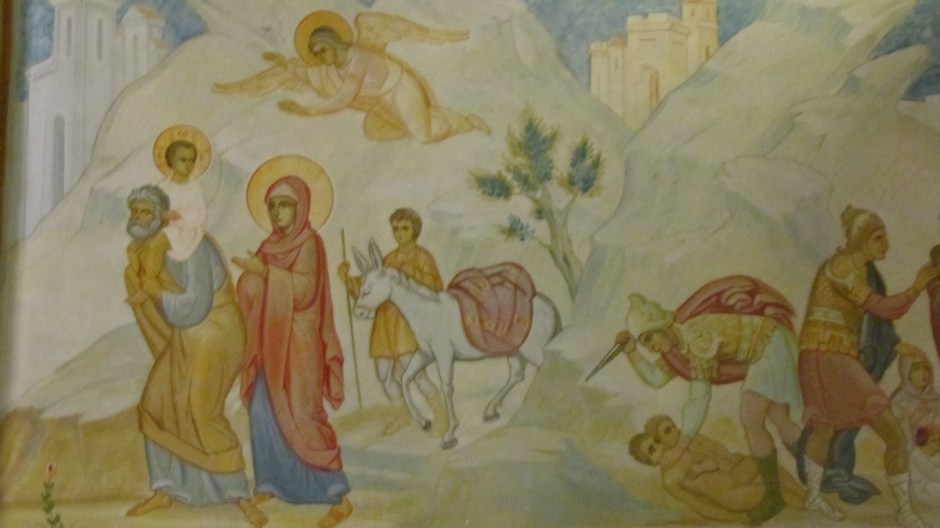
And with this worry fumbling around within, I arrived in Nazareth with our group on a hot, dusty mid-June day. We visited a church built over an ancient well that the Church remembers as the well where Mary came to draw water. Every square inch of the interior walls of the church was covered in paintings depicting scenes from the lives of Mary and Jesus. When I looked up at one showing the scene narrated in today’s Gospel reading, I burst into tears.
I’ll get back to my spontaneous weeping in a moment, but let’s stick with the Gospel reading for a minute or two. The way that Matthew’s account of the Gospel tells the story, Mary and Joseph do not settle in Nazareth until a few years after Jesus’ birth. There is no tale of traveling from Nazareth to Bethlehem, no stable, no manger, no shepherds. Those details are all in Luke‘s Gospel. In Matthew, there are three elements of the story: Joseph receiving a dream-vision from an angel telling him it is okay to wed Mary and raise Jesus, the wise people coming to Bethlehem to give Jesus gifts, and Herod’s slaughter of the infants which prompts Joseph and Mary to flee to Egypt. Unfortunately, our Gospel reading skips Herod’s atrocity, but it is the reason that Joseph, Mary, and Jesus become refugees and asylum seekers. They hide out in Egypt for a few years until an angel tells Joseph the danger has passed with Herod’s death. To avoid Herod’s son, Joseph and Mary settle in Nazareth, several days’ travel to the north of Judea.
And this brings me back to the painting in that church in Nazareth, the one that made me burst into tears. The painting depicts the Holy Family returning from Egypt. A haloed Mary and a gray-haired and -bearded Joseph walk together away from the slaughter happening on the far side of the image. And Jesus, a young boy now, rides on Joseph’s shoulders. That’s what made me cry. I had never before seen such a paternal image of Joseph. He was doing something that I did all the time! I loved giving shoulder rides! And not only that, but the look on his face in the painting is priceless. Up on his shoulders, Jesus seems to be pulling his ears, and Joseph is looking sideways at Mary in an exasperated sort of way.
That day in Nazareth, for the first time in my short years of fatherhood, I identified with Jesus’ earthly father on a deep personal level. He loved Jesus as his own child even though he could have walked away from the beginning. Like every committed parent, Joseph said “yes” again and again and again to loving Jesus, raising Jesus, and sticking with it even when he felt incompetent, exhausted, or exasperated. That painting made Joseph my biblical hero for those early years of my parenthood.
Biblical heroes can be tricky to embrace because so many characters seem untouchable – Jesus first among them. We know we are called to be like Jesus, but we also know that we’ll never get that close despite our efforts. And so we look around for other models, and it turns out the ones we do embrace happen to be the ones whose humanity shows through, allowing us to embrace ourselves, warts and all.
Peter is one such character, a man with so much influence in the early church that he could surely have suppressed the less flattering stories about himself but chose not to. Martha is another, a woman “distracted by many things,” but who is also determined to make others feel at home. Joseph, who gets precious little screentime in the Gospel, did not become my hero until I saw that painting in Nazareth. But once I saw Jesus on his shoulders, I felt a kinship to him that told me: “Perhaps I’m doing okay after all in this new fatherhood thing. Not batting 1.000, but no one ever does that. The mid .280s is pretty darn good.”
Which character from the Bible do you identity with? Why that person? What is it about their character that inspires something inside of you? How does you study of the Bible influence your day to day life? As we begin 2025, I invite you to delve deeper into your own story by connecting your story to the biblical one. Because our stories of faith continue the story of what God is doing in God’s creation. God is our author, and as God’s characters, we get to tell God’s story together.
 Where the Wind...