
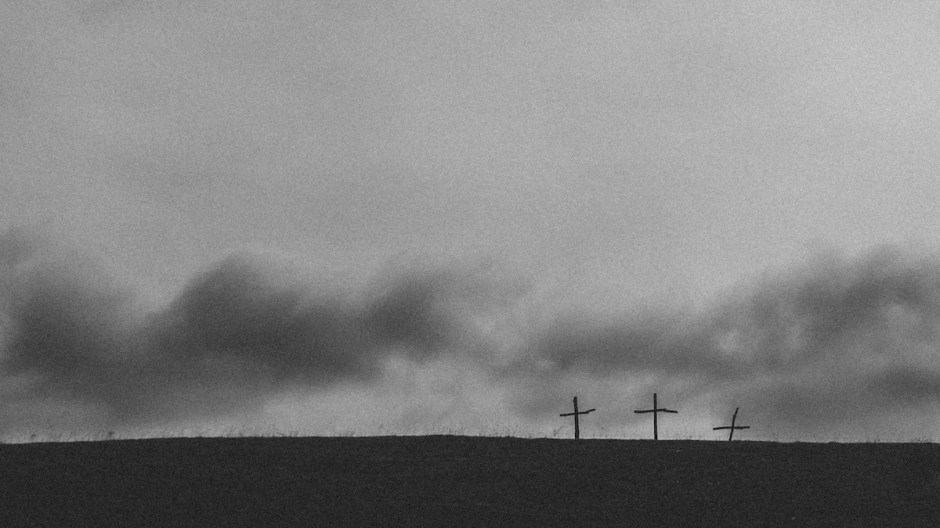
Sermon for Sunday, March 24, 2024 || Palm/Passion B || John 12:12-16; Mark 14:26 – 15:47
Right now, at this moment of today’s service, we stand halfway between one reading from the Gospel and another. We have already read the story of Jesus’ triumphant entry into Jerusalem. At the end of the service, we will read the story of Jesus’ passion; that is, his arrest, trial, walk to Calvary, and crucifixion. The first reading is short; the second is quite long. The Church did not always place these two readings on the same Sunday. Way back when, today was just Palm Sunday. But current practice combines the two to ensure that people who do not attend service on Good Friday still hear the Passion Gospel. So what we end up with is a bit of an unwieldy service that jams Palm Sunday into the first ten minutes and then moves on with the Passion. At St. Mark’s we rearrange the service a bit by placing the Passion Gospel at the very end instead of the normal spot for the Gospel reading. That’s why I’m preaching now right after the Epistle. And since we are halfway between the two Gospel readings, I thought I’d spend this short sermon acting as a pivot between the two.
We have already heard the story of Jesus’ entry into Jerusalem. He rides into the city with an odd mix of triumph and humility. The triumph comes when a great crowd takes palm branches and waves them while shouting, “Hosanna! Blessed is the one who comes in the name of the Lord— the King of Israel!” The humility comes when Jesus chooses a young donkey to sit on, rather than a more dignified steed. But even this humility fulfills the words of the Prophet Zechariah, “Don’t be afraid, Daughter Zion. Look! Your king is coming, sitting on a donkey’s colt.”
Jesus enters Jerusalem a few days before the festival of Passover. Multitudes of other pilgrims have come from all over, and the throngs of people make the Roman occupiers twitchy. And when the occupiers get twitchy, so do the Jewish officials, who do not want things to get out of hand, which would give the Romans an excuse to crack down even harder. The Jewish officials decide Jesus is a rabble rouser because of the crowd’s shouts that the King of Israel has returned. And the last thing they want is a roused rabble. Or so they think.
But an opportunity to get Jesus alone presents itself in the form of Judas. The officials arrest Jesus, give him a hasty trial so full of falsehood that Jesus needs to condemn himself by telling the truth, and then ship him off to Pontius Pilate. And now it is the officials’ turn to rouse a rabble. They incite the crowds – perhaps even some of the same people who cheered Jesus earlier in the week – to call for his crucifixion. As the officials reason in another account of the Gospel, it is better for one person to die than for the Romans to descend violently on the masses.
And so Jesus, who had ridden into the city in humble triumph less than a week before, now staggers out of the city. Soldiers have beaten him to the point that he cannot carry the bar of his own cross. Simon of Cyrene bears it for Jesus as Jesus limps his way to Golgotha. The place of his execution is outside the city, as were all crucifixions in the Roman Empire, for the empire used the gruesome spectacle as a warning to those who would challenge Roman control.
But even as Jesus staggers out of the city, he maintains the humble triumph of his entry. His humility is evident in his reliance on Simon’s strength, in his silence in the face of his detractors, and in his retention of his dignity even as he is stripped and whipped and spat upon. His triumph is evident in his fulfillment of his mission, in his solidarity with all those who are rejected from the inside of the city, in the utter lengths he goes to remain in relationship with those who have been cast out as he himself has become outcast.
And as Jesus is lifted up, in the words of an old prayer, he “spreads his arms of love on the hard wood of the cross that everyone might come within the reach of [his] saving embrace.” As I contemplate the meaning of Jesus staggering out of the city that he had so recently entered in triumph, I pray for all those who must feel like they, too, have come to Golgotha, the place of a Skull. And I pray for Jesus to keep spreading his arms of love.
Jesus spreads his arms of love while standing in the ruins of Ukrainian towns, while digging in the rubble of Gazan hospitals, while walking amidst the burning tires of a gang checkpoints in Port-au-Prince. Jesus spreads his arms of love to embrace refugees in war-torn South Sudan, to embrace courageous demonstrators who wish for self-determination in Russia, to embrace migrants looking for new opportunities in this country that invites them with the famous stirring words: “Give me your tired, your poor, your huddled masses yearning to breathe free.”
Jesus spreads his arms of love on the hard wood of the cross so that everyone might come within the reach of his saving embrace. We are part of that “everyone,” and the next piece of the prayer gives us our mission. “So clothe us in your Spirit that we, reaching forth our hands in love, may bring those who do not know you to the knowledge and love of you, for the honor of your name.” The Holy Spirit clothes us in love so that we become Jesus’ arms of love spreading out to a hurting world, reaching out beyond the city limits. On this day when we celebrate Jesus’ humble triumph, may God grant us the strength and the grace to keep reaching.
Photo by Dylan McLeod on Unsplash.
 Where the Wind...