
Sermon for Sunday, July 16, 2023 || Proper 10A || Matthew 13:1-19, 18-23
Jesus says some pretty strange stuff in the Gospel. At least this stuff is strange when we try to fit it into the way the world is instead of allowing these strange things to help us imagine a better world, a new world made more beautiful by the love, peace, and justice of God.
We try to ignore the strangeness because it’s Jesus saying these things, and we’ve had two thousand years to get used to them. But if we cast ourselves back into the sandals of those folks piled on the shore beside the sea, those folks listening to this weird, yet charismatic and compelling itinerant preacher, we hear the strangeness anew. And we realize that Jesus speaks like this because he’s trying to get people to shift their perspective, to see that new, more beautiful world.
And so Jesus says strange things like, “Love your enemies.” He says things like, “Father, forgive them, for they don’t know what they are doing.” He says things like, “The first shall be last, and the last shall be first.” And he says things like today’s parable, which includes the strangest farming practice imaginable. In a world where seed is scarce and water is limited, you better be careful where you plant your seed. But that’s not the story Jesus is telling, nor the plan of the God Jesus invites us to encounter.
In the story I just read, Jesus talks about a very strange farmer. This farmer is none too careful with his seed. Rather than strategically planting the seed in carefully tilled furrows, the farmer reaches his hand into his bag and casts the seed as broadly as he possibly can. He literally “broadcasts” the seed, like TV networks used to do before cable and streaming. The farmer is so reckless with his casting that three-quarters of the seed – 75% of the seed – falls outside the soil where it will grow the best.
So, is this farmer not just a strange farmer, but a really ineffective farmer? Or is Jesus trying to tell us something about God’s abundance? Every bag of seed carried by every other farmer will eventually run out, like when I’m baking corn muffins to have with chili and I don’t do a good job apportioning the batter across the 12-muffin tin and I have to scrape the bowl to eke out that last one, which ends up being a little puny. You know what I’m talking about right?
But this farmer in Jesus’ parable, this farmer’s bowl has never-ending batter, this farmer’s bag never runs out of seed. The seed falls literally everywhere, and that’s okay because the seed of God’s Word is endless. If I did my math right, of the total seed cast, only 8.33% bears a hundred fold return. But when the seed is infinite, it doesn’t matter how small a percentage we might conclude is effective. 8.33% of infinity is still infinity…I think. I should probably check with a mathematician.
Either way, God’s math of abundance is sound because, even though only 25% of the seed grows well in the good soil, all the seed does something. The seed the birds carry off will be planted elsewhere. The plants scorched by the sun and choked by the thorns still die into nutrients to enrich the land. We don’t know how any particular seed will grow, but we have faith in the abundance of the sower, who continues to broadcast the seed throughout creation.
This impulse towards abundance is so hard for us to embrace in a world built on the model of scarcity. The upside down priorities of the world teach us that scarce things are the most precious and valuable – things like diamonds and gold – but in the end these things are really just shiny rocks. The right side up priorities of Jesus teach us that the most precious things in the world are the ones that grow when they’re shared: things like love and peace and justice, these things that make the world more beautiful. These things may seem in short supply, but that strange farmer keeps broadcasting that seed. Some of it is planted in us, and we scatter it wherever we go.
My mother’s favorite picture book, Miss Rumphius, shares this message of Jesus’ parable way better than I can. Written and illustrated by Barbara Cooney, Miss Rumphius tells the story of Alice Rumphius, who, as a little girl, told her grandfather that she wanted to be just like him. “When I grow up, I too will go to faraway places, and when I grow old, I too will live beside the sea.” Her grandfather said, “That is all very well, little Alice, but there is a third thing you must do… You must do something to make the world more beautiful.” “All right,” said Alice, and then the narrator tells us, ‘But she did not know what that could be.’
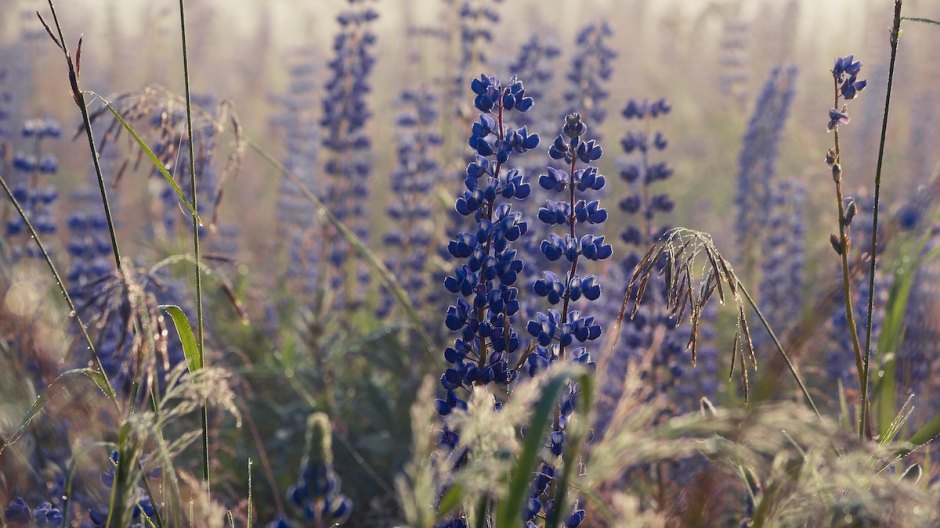
Alice grew up and did everything she wanted, including settling in a little house beside the sea, where she planted a tiny garden of lupines. ‘She was almost perfectly happy.’ “But there is still one more thing I have to do,” she said. “I have to do something to make the world more beautiful.”
The next spring she went on a walk and found a ‘large patch of blue and purple and rose-colored lupines!’ “It was the wind,” she said as she ‘knelt in delight.’ “It was the wind that brought the seeds from my garden here! And the birds must have helped!”
This gave her a ‘wonderful idea!’ ‘All that summer, Miss Rumphius, her pockets full of seeds, wandered over fields and headlands, sowing lupines. She scattered seeds along the highways and down the country lanes. She flung handfuls of them around the schoolhouse and back of the church. She tossed them into hollows and along stone walls.’
‘The next spring there were lupines everywhere. Fields and hillsides were covered with blue and purple and rose-colored flowers. They bloomed along the highways and down the lanes. Bright patches lay around the schoolhouse and back of the church. Down in the hollows and along the stone walls grew the beautiful flowers. Miss Rumphius had done the third, most difficult thing of all!”
At the end of the story, Miss Rumphius, now known as the Lupine Lady, sows one more seed into the heart of the narrator, who is her grand-niece. The narrator wants to be just like her great-aunt and “go to faraway places and come home to live by the sea.” “That is all very well,” the Lupine Lady says, “but there is a third thing you must do…You must do something to make the world more beautiful.”
“All right,” I say.
‘But I do not yet know what that can be.’
Photo by Vitolda Klein on Unsplash.
 Where the Wind...