
The Trapdoor (April 29, 2013)

…Opening To…

Come, then, Lord my God, come and instruct my heart where and how to search for you, where and how to find you. Where shall I look for you, Lord? (St. Anselm)

…Listening In…

When I look up at your skies, at what your fingers made—the moon and the stars that you set firmly in place—what are human beings that you think about them; what are human beings that you pay attention to them? (Psalm 8:3-4; context)

…Filling Up…

When I am engaged in a mundane activity—say, brushing my teeth or counting the bleary-eyed seconds until I hit snooze again or watching the digital numbers flick by on the counters at the gas station—the activity itself occupies only a tiny portion of my brain’s processing power. So the rest of my mind often wanders into other sections of my body. Sometimes, my mind meanders past my throat and lungs and finds its way down through that trapdoor in my gut. And I begin to ask those questions that make my gut twinge and pulse, like the feeling you get after narrowly avoiding a car accident.

I’ll be wrapping the floss around my fingers or anticipating the snap of the nozzle that signals a full tank of fuel, and I’ll look up at the sky and say, “Why do you care about me, Lord?” Then the cars will collide in my gut because, in that moment, everything I’ve ever believed is branded with a big red stamp of the word “FOOLISHNESS.”

Why do you care about me, Lord? This gut-twinging question doesn’t necessarily speculate on God’s existence. The question isn’t: “Do you exist, Lord?” There’s no reason to ask God if God exists. That would be like asking all the absent people in a classroom to raise their hands. Instead, the question acknowledges that God does, indeed, exist, but wonders why the heck God would ever care about an insignificant, messy, little thing like me. Of course, there’s no reason why God should care. This is truly first-rate foolishness.

(What? Foolishness? A cliffhanger? Don’t worry. This story isn’t finished yet! To be continued tomorrow…)

…Praying For…

Dear God, you are bigger than my mind can conceive. But I thank you that by your grace I can conceive even a small shadowy corner of your majesty. In Jesus Christ’s name I pray. Amen.

…Sending Out…

I leave this moment with you, God, comforted by the faith that your foolishness is wiser than human wisdom and hopeful that I might let your foolishness educate me.
Choosing Abundance (April 26, 2013)

…Opening To…

For life, with all it yields of joy and woe
And hope and fear,—believe the aged friend,—
Is just our chance o’ the prize of learning love. (Robert Browning, “A Death in the Desert”)

…Listening In…

I came so that they could have life—indeed, so that they could live life to the fullest. (John 10:10; context)

…Filling Up…

When we accept that eternal life happens even as we live our earthly lives, we can begin to see the corner of the edge of the expanse of the abundance that God offers to us. When we turn off the autopilot, we can break out of the rut of living vaguely, indistinctly – which, in truth, is not really living, but merely existing. Jesus offers us abundant life, but choosing abundance is not a one-time decision. Rather, the choice is akin to choosing your child’s name. You pick it once; you write it on the birth certificate once. But then you call your child that name for the rest of his or her life.

In the same way, choosing abundance involves actively naming the paths down which our decisions and our outlooks can lead us. We can walk down the path of scarcity or the path of abundance, the path of fear or the path of love, the path of destruction or the path of creation, the path of despair or the path of joy. Choosing abundance means that we follow Jesus down the life-affirming paths of love, creation, and joy. He’ll be with us either way, I firmly believe, but when we follow our own wills down the life-denying paths of fear, destruction, and despair, then Jesus needs to trample through the undergrowth to retrieve us. The good news is this: no matter how far down the life-denying paths we find ourselves, simply turning around makes them life-affirming paths. (The reverse is also true, but let’s not dwell on that now.)

When we choose abundance, we participate in the fullness of the eternal life that God yearns for each of us. Living this kind of life keeps us from lapsing into the background of existence. So choose to accept the gift of living fully into the being that God has made. Choose abundance. After all, God has already chosen you.

…Praying For…

Dear God, you are the source of all life and the cause of creation. Help me to live my life so that I always trend toward the life-affirming path of abundance, love, creation, and joy. In Jesus Christ’s name I pray. Amen.

…Sending Out…

I leave this moment with you, God, ready to step into the spotlight of my life and shine in the brilliance of your presence.

Turning off the Autopilot (April 25, 2013)

…Opening To…

For life, with all it yields of joy and woe
And hope and fear,—believe the aged friend,—
Is just our chance o’ the prize of learning love. (Robert Browning, “A Death in the Desert”)

…Listening In…

And yes, you want truth in the most hidden places; you teach me wisdom in the most secret space… Create a clean heart for me, God; put a new, faithful spirit deep inside me. (Psalm 51:6, 10; context)

…Filling Up…

When we step out of the fuzzy background of our existence and embrace the eternal life of knowing God, we discover that there’s an internal switch that has been set in the wrong position. Each of us has within us a switch that controls the autopilot. Now, I’m not talking about the hypothalamus, the part of the brain that regulates the parts of the body that we’re not fully aware of. We should probably leave that switch on. I’m talking about the autopilot that offers us the comfortable ability to sit back and read a magazine when we should be living.

When the autopilot is engaged, we travel day to day in the generally correct direction. The wings stay parallel to the ground. We don’t deviate course. We go about our daily lives because daily life is what happens when we wake up in the morning. (This might sound familiar because I talked about something similar on Tuesday.) But when you turn off the autopilot, you have to pay attention. You have to grip the yoke to keep the plane steady. You have to check course to make sure you going in the right direction. Disengaging the autopilot makes you engage life – both the life you are living as you go about your day and the life you are living within yourself. This interior life happens with equal parts mind, heart, soul, and spirit. It is in this internal space that you can check yourself to make sure you are living the kind of life God desires for you to live. When the autopilot is on, we don’t even realize we should make such checks.

Look to your internal fuselage: in what position is the autopilot switch. If it’s on, why not try flipping it and seeing what happens next?

…Praying For…

Dear God, the life that you offer elevates us from simple existence. Help me to take an active role in my own life, both the life that other people see and the life within that only you and I can see. In Jesus Christ’s name I pray. Amen.

…Sending Out…

I leave this moment with you, God, ready to step into the spotlight of my life and shine in the brilliance of your presence.

Don’t Wait for Death (April 24, 2013)

…Opening To…

For life, with all it yields of joy and woe
And hope and fear,—believe the aged friend,—
Is just our chance o’ the prize of learning love. (Robert Browning, “A Death in the Desert”)

…Listening In…

When Jesus finished saying these things, he looked up to heaven and said, “Father, the time has come. Glorify your Son, so that the Son can glorify you. You gave him authority over everyone so that he could give eternal life to everyone you gave him. This is eternal life: to know you, the only true God, and Jesus Christ whom you sent.” (John 17:1-3; context)

…Filling Up…

There’s a common misconception among Christians that the “eternal life” that Jesus promises doesn’t begin until after we die. This thinking has led Christians of different persuasions down varying paths. Some have decided that eternal life must be earned and set about attempting to stock up points in the win column. Others have decided that eternal life includes time after we die in a place of trials intended to, once and for all, wash sin away; what we do on earth can contribute to the length of our stay in this place labeled “purgatory,” but pretty much everyone is going to have to serve time. (But don’t worry, proponents say, the eternal nature of life means that those years spent being “purged” are just a drop in the bucket.) Still others have gone to the opposite extreme, citing the fact that it doesn’t matter what we do on earth because Jesus’ act of sacrificial redemption is good enough to cover everything that is necessary for eternal life.

Whether or not you subscribe to one or more or none of these types of doctrines, they all have one thing in common; they draw a line between life here on earth and “eternal” life in the hereafter. But if you look at Jesus’ prayer above, you’ll notice that he makes no such distinction. You don’t have to wait for death for eternal life to begin. The very notion of something “eternal” beginning doesn’t really make since if you think about it. Eternal things just are. If they had to begin, they wouldn’t be eternal. (I’m aware that the last few sentences could lead to some very interesting discussions, but we don’t have space to have them just now.)

Here’s what I’m getting at: if we mistakenly wait for death for our eternal lives to begin, we are missing out in the here and now on the abundance that Jesus offers us when we share in his life. Waiting for death before we access eternity can actually lead us away from life and into the vagueness of mere existence. But accepting that we have eternal life – now, here – can lead us to find the fullness of the life that Christ gives us to share in.

…Praying For…

Dear God, you are the eternal presence that frames existence and the creative presence that breathes life into being. Help me to know you, and in knowing you, find the eternal, abundant life that you offer to all. In Jesus Christ’s name I pray. Amen.

…Sending Out…

I leave this moment with you, God, ready to step into the spotlight of my life and shine in the brilliance of your presence.

The Background of my Own Life (April 23, 2013)

…Opening To…

For life, with all it yields of joy and woe
And hope and fear,—believe the aged friend,—
Is just our chance o’ the prize of learning love. (Robert Browning, “A Death in the Desert”)

…Listening In…

In Jerusalem near the sheep gate in the north city wall is a pool with the Aramaic name Bethsaida… A certain man was there who had been sick for thirty-eight years. When Jesus saw him lying there, knowing that he had already been there a long time, he asked him, “Do you want to get well? (John 5:1, 5-6; context)

…Filling Up…

The next time you watch TV, take note of the fact that the camera can only focus on things at one particular distance away from it. Your eyes will be drawn to what is “in focus,” whether the camera focuses on the foreground, the middleground, or the background. Directors use various foci when filming to help tell the story: a character in the middleground might be in focus at the beginning of a scene, but then the camera will adjust to an object in the foreground, showing the audience that the character is looking intently at the object. Rarely is the background the focus of the scene. You can see what is there, but usually objects in the background are indistinct and fuzzy. The characters who stand in front of it are moving and vibrant – and in focus.

It’s quite easy to fall into patterns that lead us to exist solely in this indistinct background part of our own lives. We go about our daily routines: we get up, brush our teeth, shower, go to school or work, come home, watch NCIS, brush our teeth again, and go to bed. And then we do it again tomorrow (except that we have to wait till next week for NCIS). Now, routines aren’t bad or evil – in fact, they can be quite comforting, and some folk need the stability they offer more than they need anything else. But when routine becomes rut, and we do the things we do simply because they offer the path of least resistance, then we will have lapsed into the backgrounds of our own lives. We will have become indistinct, fuzzy versions of ourselves that exist as part of the scenery and not the action.

There’s a reason that this scenery is called “sets.” Everything is set, in place, not going anywhere. But God, I don’t think, let’s us stay “set.” God moves in both the backgrounds and foregrounds of our lives, and this movement pushes and pulls us into sharper focus. We can, of course, continue to exist as fuzzy background filler. But wouldn’t it be better to live in focus?

…Praying For…

Dear God, focusing on you brings my life into sharper focus. Help me to be attentive to your movement so that I may resist the wearying forces of existence that pull me into the background. In Jesus Christ’s name I pay. Amen.

…Sending Out…

I leave this moment with you, God, ready to step into the spotlight of my life and shine in the brilliance of your presence.

The Previous Ten Minutes (April 22, 2013)

…Opening To…

For life, with all it yields of joy and woe
And hope and fear,—believe the aged friend,—
Is just our chance o’ the prize of learning love. (Robert Browning, “A Death in the Desert”)

…Listening In…

Jesus told this parable: “A man owned a fig tree planted in his vineyard. He came looking for fruit on it and found none. He said to his gardener, ‘Look, I’ve come looking for fruit on this fig tree for the past three years, and I’ve never found any. Cut it down! Why should it continue depleting the soil’s nutrients?’ The gardener responded, ‘Lord, give it one more year, and I will dig around it and give it fertilizer. Maybe it will produce fruit next year; if not, then you can cut it down.’ ” (Luke 13:6-9; context)

…Filling Up…

Have you ever been driving your car for a while and then realize all of a sudden that you don’t remember anything that happened in the previous ten minutes? More than once when I used to drive up and down I-79 in the middle of Everything-Looks-the-Same, West Virginia, I would do just that. I would look out the windshield and surprise myself with the uncomfortable fact that I was on a highway in the midst of many large, metal automobiles traveling 73 mph. Let’s see: the little Hyundai I drove back then weighed 2366 pounds. Toss in another 180 pounds for passenger and luggage. Converting to metric and employing some rules from Sir Isaac, I find that my car’s momentum was 3850N-s (that’s Newton-seconds, whatever those are). Now, I don’t know much about physics, but that seems like a lot of momentum, and I have seen my share of high-speed motor vehicle collisions. How could I ever fail to pay attention for ten seconds, let alone ten minutes?

If I can’t pay attention when doing something potentially dangerous such as driving, how often do I let everything that passes me simply flatten into mere scenery, leached of color and motion? How often do I lapse into the background of my own life? How often do I look at people and not see them or hear a voice and not listen for its meaning and timbre? The answer: pretty darn often, because life is so much easier on autopilot. Easier, but then again, I’m not sure that counts as living.

This week we are going to talk about the difference between simply existing and living – living into the fullness that God yearns for each of us. So stay tuned.

…Praying For…

Dear God, your encounter with Saul left him forever changed. Help me to recognize the changes that you have caused to happen in my life and be thankful for them. In Jesus Christ’s name I pray. Amen.

…Sending Out…

I leave this moment with you, God, ready to step into the spotlight of my life and shine in the brilliance of your presence.

By the Hand (April 19, 2013)

…Opening To…

The Road goes ever on and on
Down from the door where it began.
Now far ahead the Road has gone,
And I must follow, if I can… (J.R.R. Tolkein, The Lord of the Rings)

…Listening In…

During the journey, as he approached Damascus, suddenly a light from heaven encircled him. He fell to the ground and heard a voice asking him, “Saul, Saul, why are you harassing me?” (Acts 9:3-4; context)

…Filling Up…

When I began writing this week’s devotions, I didn’t realize how much of a link there is between blindness and stories that take place on roads. Here’s another one! Saul – who later becomes Paul – has been no friend to persons who “belonged to the Way.” (At this point, “Christianity” wasn’t a word yet, so Jesus’ followers were identified as those belonging to the “Way.” Remember, “way” and “road” are the same word.)

But while he is following the road to Damascus, Saul suddenly finds himself flat on his back. A blinding light flashes around him and he hears Jesus’ voice say, “Saul, Saul, why are you harassing me?” When Saul’s companions, who are completely unaware of the light show, pick him, Saul opens his eyes and realizes he can’t see. After this, according to Acts, “they led him by the hand to Damascus.”

This detail is truly amazing. Saul had been so certain of the rightness of his cause of persecuting those who followed the Way of Jesus. Saul had been so certain. But when he encounters Christ, his certainty vanishes. He is unable to walk for himself and needs others to guide him. And so they take him by the hand and bring him to his destination.

Sometimes, we can be so certain of where we are going that we forget to look for Christ on the road. It’s a good thing, then, that, when we fall victim to spiritual blindness, there are others around us who can take our hands and guide us on the way.

…Praying For…

Dear God, your encounter with Saul left him forever changed. Help me to recognize the changes that you have caused to happen in my life and be thankful for them. In Jesus Christ’s name I pray. Amen.

…Sending Out…

I leave this moment with you, God, strengthened by your love and able to walk another day on weary feet

Hearts on Fire (April 18, 2013)

…Opening To…

The Road goes ever on and on
Down from the door where it began.
Now far ahead the Road has gone,
And I must follow, if I can… (J.R.R. Tolkein, The Lord of the Rings)

…Listening In…

They said to each other, “Weren’t our hearts on fire when he spoke to us along the road and when he explained the scriptures for us?” (Luke 24:32; context)

…Filling Up…

Yesterday, we talked about Bartimaeus, a blind man who doesn’t start making his way down the road until Jesus restores his sight. Now, most of us persist in our spiritual blindness even as we grope along looking for the road, so it’s a good thing that you don’t actually need to be able to see to start making your way down the road.

In fact, there’s a story that deals with just that. On the day of the resurrection, two of Jesus’ followers, Cleopas and another unnamed person, travel home from Jerusalem to Emmaus (half a day’s walk, give or take). These two fairly unimportant folks are walking down the road when they meet another traveler. We know this newcomer is Jesus, but they don’t see him for who he is. While they are walking along the road, they are blind to the reality of the Risen Christ in their midst.

When they sit down at table later on and Jesus breaks the bread, they recognize him with their eyes. Then they say something peculiar: “Weren’t our hearts on fire when he spoke to us along the road…” While we are traveling along the way of Jesus Christ, we rely on more than just our sight to guide us. It is not until they see Jesus with their eyes that these two disciples realize something inside of them told them what was going on hours earlier on the road. Call it intuition. Call it instinct. Call it the presence of God pulling each of them and each of us into closer relationship.

This pull happens while we are traveling down the road with Jesus – we don’t need to see it to feel the pull tugging us back to God.

…Praying For…

Dear God, your son’s presence made the travelers’ hearts burn within them. Help me to recognize that same fire within me whenever I start to doubt your presence in my life. In Jesus Christ’s name I pray. Amen.

…Sending Out…

I leave this moment with you, God, strengthened by your love and able to walk another day on weary feet

Beside the Road (April 17, 2013)

…Opening To…

The Road goes ever on and on
Down from the door where it began.
Now far ahead the Road has gone,
And I must follow, if I can… (J.R.R. Tolkein, The Lord of the Rings)

…Listening In…

Jesus and his followers came into Jericho. As Jesus was leaving Jericho, together with his disciples and a sizable crowd, a blind beggar named Bartimaeus, Timaeus’ son, was sitting beside the road. (Mark 10:46; context)

…Filling Up…

This week we are talking about roads. Before we start walking down the road, we first have to get on it. There’s a wonderful story in the Gospel according to Mark featuring a man named Bartimaeus, who is blind. Now, Mark chooses his words economically, usually narrating scene with quick, urgent sentences and then moving on to the next story. But during the short interchange between Jesus and Bartimaeus, Mark gives us an unusual level of detail that is quite fascinating.

First, as Mark sets the scene, Bartimaeus is sitting “beside the road.” This is only natural, considering he is a beggar. When he hears that Jesus is coming along, he starts shouting out, “Son of David, show me mercy!” This catches Jesus’ attention and he calls Bartimaeus over. Mark tells us that the beggar “throws” his coat aside and “jumps up,” probably scattering the coins he had received that day. He goes over to Jesus, asks for the ability to see, and Jesus says, “Go, your faith has healed you.”

Bartimaeus interprets this “Go” as an invitation. Perhaps, he reaches into the recesses of his mind and remembers God telling Abram simply to “Go.” And Abram, who later becomes Abraham, “went,” thus launching the relationship between God and the people of Israel. Bartimaeus receives his sight and then “goes” by following Jesus on the “way.” No longer is Bartimaeus a passive sitter “beside” the road; rather, he is an active walker on the road.

Too often in my life, I find myself sitting beside the road instead of walking along it. Bartimaeus waited until he received his sight to follow. What are we waiting for?

…Praying For…

Dear God, you instill in me the desire to follow and grant me the tools to do so. Help me jump up from my reclining position and walk with you down the road. In Jesus Christ’s name I pray. Amen.

…Sending Out…

I leave this moment with you, God, strengthened by your love and able to walk another day on weary feet

They Call it Heartbreak Hill

I first published this reflection on the website Day1.org. You can see it here.

fenceThey call it Heartbreak Hill. It rises between the twentieth and twenty-first miles of the route of the Boston Marathon. It’s not much of a hill, unless you’ve been running for twenty miles and have no more glycogen left to power your leg muscles. You see this gradual rise and you know you only have six miles left, but then you hit the wall and your will to keep running vanishes. That’s why they call it Heartbreak Hill.

But at yesterday’s marathon, the heartbreak was elsewhere. It was at the finish line, where the bombs detonated. It was on Boston Common, where the final waves of runners were rerouted and then left to seek out frantic family members. It was at local hospitals, where trauma teams worked round the clock with valiant and tireless conviction. It was in the heart of each of us watching the confused, yet ardent news coverage.

And it was in the heart of God.

The heart of God broke yesterday along with ours. The heart of God broke for those who died in such senseless savagery, for those who were maimed, and for those who love them. The heart of God broke because those of God’s children who perpetrated this act of terror have severed themselves from the image of God within them.

So what are we to do with a God who has a broken heart? The answer might surprise you. What are we to do? Rejoice. Why? Because our God is a God of compassion, a God who suffers with us, a God who was there yesterday when the plumes of smoke began to rise and the tears began to fall.

To rejoice, we do not have to stop feeling sad or angry or lost or afraid. As a matter of fact, the most sincere rejoicing happens when we feel such feelings. To rejoice is to take joy, and joy is the abiding sense of God’s connectedness with God’s creation. Today, we need to feel that connection, we need to feel God suffering with us, and we need to feel God’s heart breaking. We need to feel these things because when God’s heart breaks, our own broken hearts are drawn to it – mystically and magnetically.

I live a short bus ride, a red line train ride, and a green line train ride from Copley Square. I have walked past Marathon Sports many times in the last few years, usually on the way to a restaurant or Trinity Church. But every time I walk by it now, I will remember God’s heart breaking yesterday and swallowing all of our collective brokenness into its depths of love.

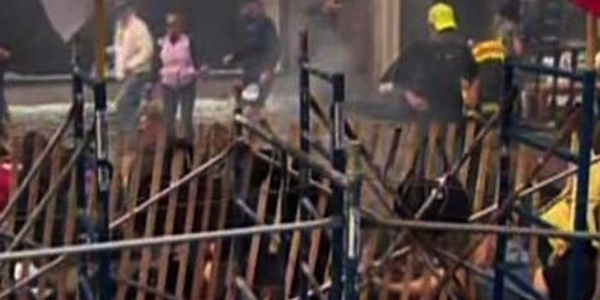
Speaking of love, there’s an image from yesterday’s shaky video footage that I can’t get out of my mind. Within thirty seconds of the first bomb’s detonation, emergency responders were running to the sight of the blast. But they couldn’t get there because a barrier had been erected to separate the spectators from the runners. So the emergency personnel started tearing at it, stomping on it, and pulling it with all their might. It took a dozen of so of them to move it, but once they exerted their frenzied energy, the barrier didn’t stand a chance. They dragged the multiple layers of the wall into the street and rushed to help the victims.

I can’t think of a better image for what God accomplished in the resurrection of Jesus Christ, which we continue to celebrate during this season of Easter. Once for all, God tore down the barrier between life, death, and new life. God proclaimed God’s willingness to stay connected to God’s creation, come what may. God finished the race, won the victory, and left death behind, struggling up Heartbreak Hill. In the power of the resurrection, the heart of God, which broke when Jesus hung broken on the cross, was healed. And in the power of the resurrection, all of our broken hearts will find wholeness again.