
Sermon for Sunday, December 15, 2024 || Advent 3C || Luke 3:7-18
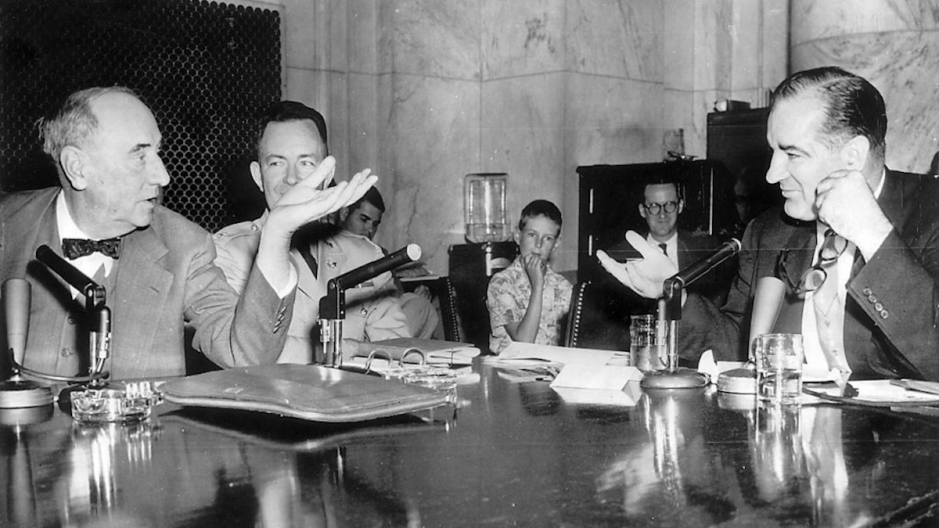
On June 9, 1954, Senator Joseph McCarthy sat in a hearing room and attacked a young lawyer named Fred Fisher for communist sympathies. Fisher was a member of Joe Welch’s law firm, and Welch did not take kindly to McCarthy bringing up Fisher, considering Welch had a deal with McCarthy’s own lawyer, Roy Cohn, that neither Fisher’s past nor Cohn’s own dubious history of missing the Korean War draft would be brought up at the hearing. But McCarthy could not help himself. And so Joe Welch spoke words that have gone down in history, thanks both to their televised nature and their puncturing of McCarthy’s indestructible aura. “Have you no sense of decency?” Welch asked. “At long last have you left no sense of decency?”

“WheretheWind.com Sermon” on your podcast app of choice.
That’s what I’d like to talk about today: Decency. Welch’s words effectively ended McCarthy’s career because they spoke the truth that no one had been willing to acknowledge publicly before that moment. McCarthy had abused his power for years, destroying the reputations of so many people. Finally, at that hearing, someone spoke up. And Welch’s words acted like a hypnotist snapping a person out of their hypnosis. The country, as a whole, stopped following the indecent McCarthy. He faded into obscurity and died three years later.
Decency is an interesting concept. At first glance, it seems like a fairly low bar to clear. A “decent” chicken parmesan is tasty and filling, but you don’t dream of it months later like I do thinking about the chicken parm from Andiamo. A “decent” major league hitter might bat in the mid to upper .200s. He’s reliable, but nowhere near hall-of-fame caliber. Far from extraordinary, the concept of decency refers to an acceptable standard, be it for a cup of coffee or moral behavior.
I’m thinking about decency today because of the speech John the Baptist gives to his audience in today’s Gospel reading. He begins with the flamethrowing introduction, “You brood of vipers! Who warned you to flee from the wrath to come?” Whoa. Now he’s got their attention. He’s calling them children of snakes – evoking the story of Adam and Eve, that fateful tale in which humanity decided we did not need God. Instead of bearing fruit like Adam and Eve ate at the serpent’s behest, John says, bear fruits worthy of repentance; that is, show forth in all your relationships a change of heart and mind towards the life-giving priorities of God.
But John doesn’t stop there. He preempts an argument that he expects his opposition to make, saying, “Do not begin to say to yourselves, ‘We have Abraham as our ancestor.’” John stands totally against the people resting on their laurels and allowing their ancestry to count for 100% of their relationship with God. Bear good fruit, John pleads with his crowds. If you don’t, your fruit tree will be chopped down and thrown in the fire.
This gets their attention even more! The crowds ask him, “What then should we do?” I think they’re expecting some epic task or ritual to perform in order to return to right relationship with God – something like, “Journey to the east until you come across a lonely mountain. Hike to its summit and wait until the snow begins to melt. Pluck the first snowdrop and bring it across the sea to a certain volcano. Cast the snowdrop into the fire and your sins will be forgiven.”
But John says nothing of the sort. Rather, he tells them, basically, to be decent people.
“Whoever has two coats must share with anyone who has none; and whoever has food must do likewise.”
So, according to John, in order to bear good fruit, we should share out of our abundance. Rather than hoarding resources for ourselves, we should look to make a society in which everyone has enough to thrive. That sounds like the decent thing to do.
Then John goes further. The Gospel tells us, ‘Even tax collectors came to be baptized, and they asked him, “Teacher, what should we do?” He said to them, “Collect no more than the amount prescribed for you.” Soldiers also asked him, “And we, what should we do?” He said to them, “Do not extort money from anyone by threats or false accusation, and be satisfied with your wages.”’
So, according to John, tax collectors should do their jobs without corruption, and soldiers should do their jobs without violent extortion. Like I said before, decency seems to have a pretty low bar.
But here’s the thing. Decency might be a pretty low bar, but the effects of cultivating decency far surpass the ease of living in a decent manner. Moral decency is the soil in which other life-giving values grow. The most important of these values is dignity. Dignity is the action of having our human worth respected, independent of any assigning of economic or personal significance. In our Baptismal Covenant, we promise, with God’s help, to respect the dignity of every human being.
When we respect dignity, we see and honor a whole person, rather than reducing someone to a specific element of their identity. For example, author of Just Mercy, Bryan Stevenson, passionately invites everyone to see people on Death Row as fully human and not only as inmates who are defined by the worst thing they ever did.
Embracing moral decency means treating everyone with dignity. We can begin this through changing our speech patterns towards person-centered language. When contemplating the history of slavery in this country, we remember people not as “slaves,” but as “enslaved people.” This change in speech engenders a change in perspective – slavery is not a sole identity but a condition that another human put upon them. In today’s world, instead of saying, “the homeless,” we say, “people who are unhoused.” This engenders another change in perspective: we see the person first, instead of shoehorning them behind the “problem” we have decided they are facing. This change of perspective, which is a type of repentance, can galvanize us into action, because we now have the ability to enter a new kind of relationship – one that begins with the person instead of the “problem.”
All of this may seem a little too simple for people following Jesus Christ down the spiritual path. Shouldn’t it be flashier than this, more prestigious? No – following Jesus happens in the everyday moments, not the epic quests. Or perhaps, the everyday moments make up our epic quests – epic quests in which we join with God in making this world a place where decency is a given and dignity something no one ever has to earn. My prayer for each one of us today is that we embrace our own dignity, so that we might see the dignity of others in the mirror of their souls. My prayer today is a prayer for common decency to flood our hearts, clearing the way for God to inspire us towards love and good deeds.
 Where the Wind...