

Sermon for Sunday, October 8, 2023 || Proper 22A || Exodus 20:1-4, 7-9, 12-20
Our first reading today from the book of Exodus recounts God speaking to Moses what we call the Ten Commandments. Whenever I read the Ten Commandments, I think of that great gag in Mel Brooks’s wildly inappropriate film History of the World, Part One, when Brooks, playing Moses, comes down the mountain with three tablets and says, “The Lord has given unto you these fifteen…” but then he drops a tablet and it shatters on the ground… “Ten! Ten Commandments!”
It’s pretty telling that this joke from an old movie is the first thing that comes to my mind when I think about the commandments. To be honest, for a long time they weren’t all that central to my practice of Christianity. I’ve always known them in the same vague way that you sort of know the words to old folk songs – you can sing along with them, but probably not do a solo.
I think my lack of relationship to the commandments is twofold. First, when I was growing up in Alabama, the Ten Commandments were used as a sort of political flash point. There was a state judge who installed a statue of the commandments in his courtroom and declared that he would run his court by the Ten Commandments, instead of (or at least above) the Constitution. He got all sorts of publicity for the stunt, making him well-known enough to run for the U.S. Senate years later. (He lost, but not because of the Ten Commandments thing.) The whole debacle of the commandments in the courtroom made me wary of the Ten Commandments because they seemed to have been turned into a political litmus test.
The second reason I never gave much thought to the commandments is that all but two of them are formulated as prohibitions, as things you should not do. Thou shalt not… This makes living the wisdom of the commandments pretty hard. There’s nothing we can do to accomplish the commandment: “You shall not steal.” Accomplishing this commandment is all about not doing something. Think of it this way: when you’re learning to play soccer, you learn pretty quickly the one big no-no – don’t use your hands. But after sharing this one thing you shouldn’t do, the coach spends all their time drilling you on what you should do: how to pass and dribble and defend and trap the ball.
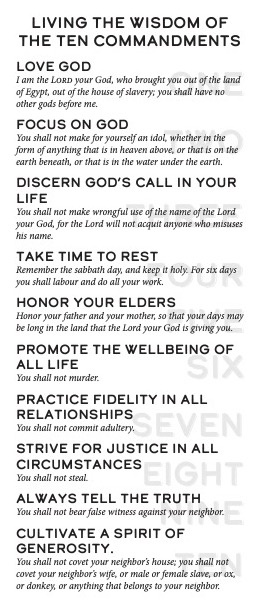
It wasn’t until I heard the Godly Play story about the Ten Commandments that I realized you could flip the commandments around. The story turns them into positive statements – it calls the commandments the “Ten Best Ways.” After hearing that story, the commandments meant so much more to me because I could actively live their wisdom instead of just guarding myself from breaking them.
When we reframe all the commandments the way the Godly Play story does, they actively engage our imaginations, affect our priorities, and lead us to closer companionship with Jesus Christ.
The first two commandments begin the list for a reason: they are the most important. “I am the LORD your God…you shall have no other gods before me. You shall not make for yourself an idol.” Living the wisdom of these commandments means ordering our priorities again and again to place God first. Because so many other things clamor for our attention, it’s easy for us to let God slip down the list. But when we keep God at the top, the other things have a way of shaking out into the right places. The more we focus on God, the more we allow God to shape our focus on the rest of life. By looking for God always, we end up discovering what God would have us see.
The third commandment: “You shall not make wrongful use of the name of the LORD your God.” I can’t tell you how many people have apologized to me for saying “Oh my God!” or “For Christ’s sake!” in my presence – or for just swearing in general. I hate that so much. I don’t care, because that’s not what this commandment is about. It’s not about swearing – or what we called in Alabama “cussing.” It’s about not invoking God’s name as a warrant for actions that run counter to God’s priorities. Living the wisdom of this commandment, then, is all about our active and prayerful discernment, both personal and communal, about how God is calling us to act in the world.
The fourth and fifth commandments are already formulated as positive actions. “Remember the Sabbath day, and keep it holy.” In other words, take time to rest in God’s presence in order to renew your devotion. Make a commitment to lie fallow so that, like uncultivated farmland, nourishment can seep back into your souls. “Honor your father and your mother.” In other words, commit to relationships that will last. Let the wisdom of age and experience speak. Allow tradition and memory to help shape the future.
The last five commandments all prohibit certain egregious acts. So how do we live their wisdom through positive action?
Number Six: “You shall not murder” becomes “Make choices that promote the wellbeing of all life.” So many of our choices feed unconsciously into the broken systems of this world that deny this wellbeing to a substantial number of people. Therefore, this commandment compels us to make all our choices consciously, so we know how they affect other people as well as the planet we live on.
Number Seven: “You shall not commit adultery” becomes “Practice fidelity in all your relationships.” Be committed to your friends and loved ones through thick and thin. Be the person in whom others confide their hopes and fears. Be reliable. Be devoted. Be loyal. And in so doing, discover how much deeper your relationships can go.
Number Eight: “You shall not steal” becomes “Strive for justice in all circumstances.” Be a force for raising up those who have had their livelihoods stolen by the greed of others. Be an outspoken proponent of justice and equitable treatment for all. Live with integrity.
Number Nine: “You shall not bear false witness” becomes “Always tell the truth.” Be like the child at the end of The Emperor’s New Clothes, speaking the truth even when it’s unpopular. Be honest, no matter how hard it is or how disadvantaged you end up being in a world full of lies. In the end, the truth is easier to remember anyway.
And Number Ten: “You shall not covet” becomes “Cultivate a spirit of generosity.” Be welcoming. Be hospitable. Carry what you own lightly, neither grasping nor hoarding, but remembering that nothing really belongs to us in the long run.
With this exercise in turning the prohibitions around, my intent is not to discard the Ten Commandments as we have received them, but to make them more central to our daily walks with God. As you walk with Jesus down the path of discipleship, live the wisdom of the commandments: Love God. Focus on God. Discern God’s call in your life. Take time to rest. Honor your elders. Promote the wellbeing of all life. Practice fidelity in all relationships. Strive for justice in all circumstances. Always tell the truth. And cultivate a spirit of generosity.
As you leave the service today, I invite you to take one of these lists and put it on your fridge. Each day, choose one reformulated commandment and act it out intentionally throughout the day. How does actively living the commandments change your priorities, your focus, your relationships? In what ways does this active living help you grow deeper in your life of faith? I truly hope you will engage these commandments because living their wisdom has helped me so much in my walk with God. Even if we had the other five commandments that Mel Brooks dropped, I can’t think of a better way to live.
 Where the Wind...